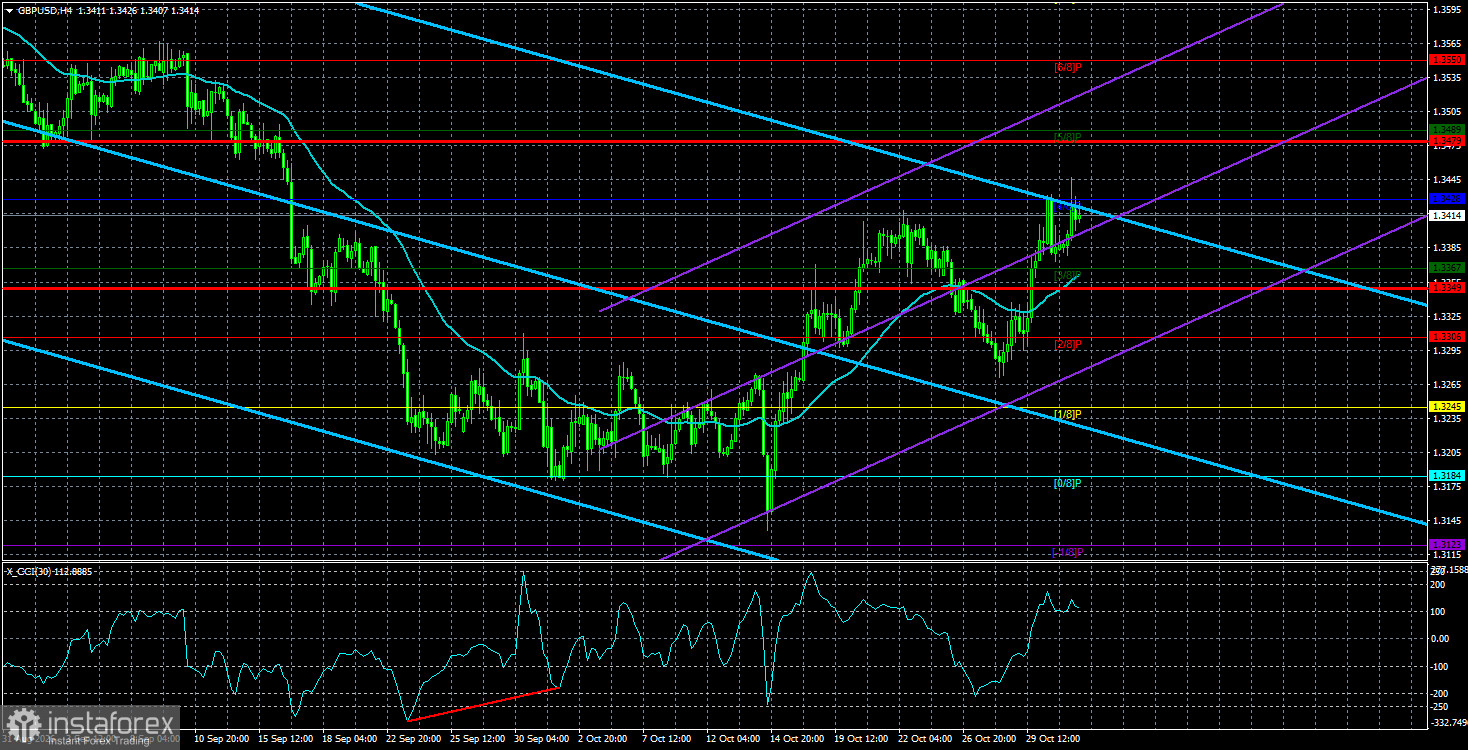
The GBP/USD currency pair also traded higher on Monday. The British pound has been trading as technically and predictably as possible in recent weeks and even months, unlike the euro. We repeat the same thing every day about the technical picture on higher timeframes because this is indeed an important point and factor. And again — the pound's current upward movement can occur solely on technical grounds. Price remains inside two sideways channels on the daily and weekly timeframes, bouncing off their lower boundaries and forming deviations. Thus the pound's rise should have occurred even without fundamental or geopolitical support.
On Monday, it became known that a peace-seeking Donald Trump does not want to resume a war with Iran and again wants to give diplomacy a chance. The US president can be understood — his political ratings are "below the floor" even without a new war with Iran, the probability of Republican victory in the elections falls every day, and a "successful success" for America refuses to arrive. Trump basically repeats the same mantras every day: he is the best president in US history, and according to social polls, his approval is off the charts. The truth is no one has seen those polls, and who conducted them and when — nobody knows. But the whole world has already grown used to Trump's empty promises and statements. The fact remains — the American leader understands that a new war in the Middle East will not solve US problems, will not reduce fuel and oil prices, will not allow Washington to achieve its goals, and will not bring hundreds of billions of dollars into the budget. Therefore, in essence, it is pointless, as military experts have said more than once.
However, geopolitics is clearly not the top priority for traders right now, no matter what anyone says. Certainly, the rise of the euro and the pound on Monday can be linked to another easing of geopolitical tension, but the "geopolitical swings" have persisted for many months. Trump alternately wants to wage war and promises to destroy Iran, then he does not want escalation and gives Iran a chance at talks. Time passes, and the US president's statements repeat in a circle.
The key event for the market this week is the Bank of England meeting, at which the key rate is expected to be raised for the first time in several years. We have said many times that inflation is rising not only in the US, and tightening monetary policy will be carried out not only by the Federal Reserve. In the EUR/USD pair, the market pays no attention to European Central Bank tightening. But the pound, as we recall, trades more predictably, so a Bank of England rate hike should support sterling. We believe the pound can return to 1.3650 in the coming weeks without much effort. Beyond that, everything will depend on whether the price remains in the sideways channel on the daily chart. If it does, we could see a new decline for no fundamental or other reason. If not — the global uptrend of 2022 will resume, and everyone will immediately forget why and how the dollar rose in 2026.
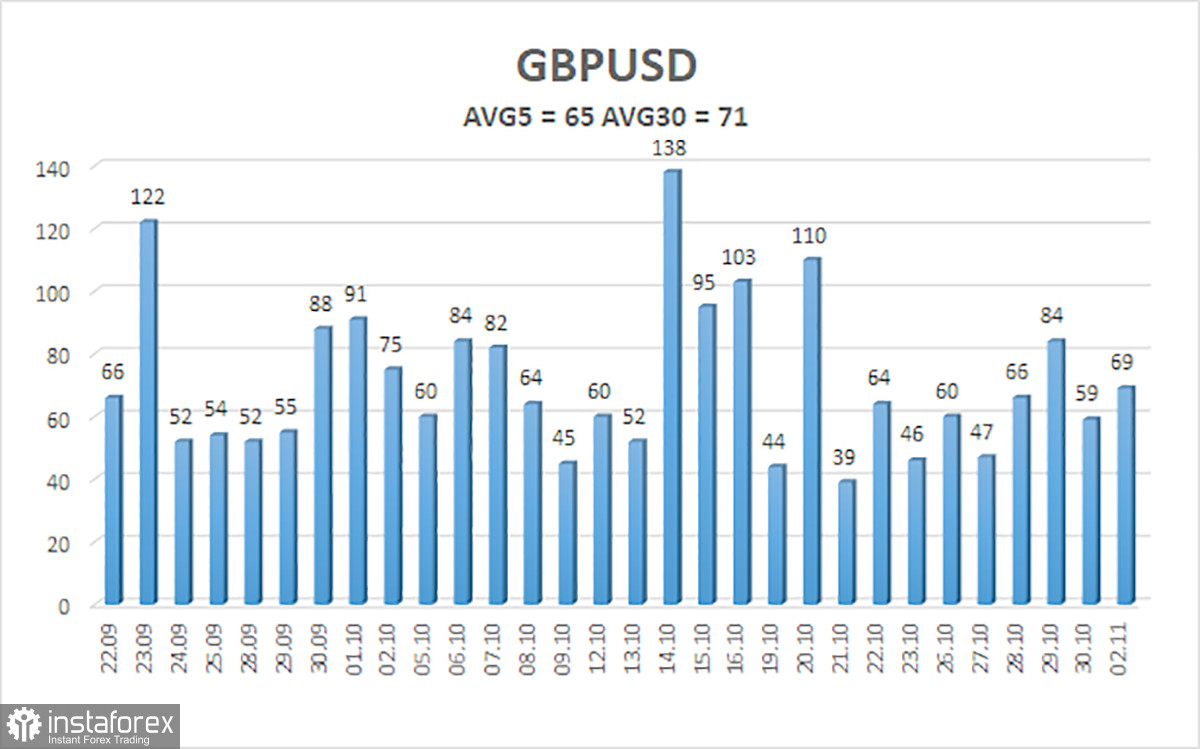
The average volatility of the GBP/USD pair over the last 5 trading days is 65 pips. For the pound/dollar pair, this value is considered "average." On Tuesday, November 3, we therefore expect movement within a range bounded by 1.3349 and 1.3479. The major linear regression channel has turned down again. The CCI indicator entered the oversold area twice and also formed a "bullish" divergence, which warned of the end of the downtrend.
Nearest support levels:
S1 – 1.3367
S2 – 1.3306
S3 – 1.3245
Nearest resistance levels:
R1 – 1.3428
R2 – 1.3489
R3 – 1.3550
Trading recommendations:
The GBP/USD currency pair has begun an uptrend that could become the start of a sustained trend. Donald Trump's policies will continue to put pressure on the US economy, so we do not expect long-term strengthening of the US dollar. The year 2026 has been positive for the dollar so far due to geopolitics and inflation, which forced capital to seek safety and prompted the Fed to return to monetary tightening. However, on the weekly timeframe, a flat remains between 1.3150 and 1.3780 within a four-year uptrend, which supports expectations of sterling's appreciation in the medium term. Consider long positions with targets of 1.3479 and 1.3489 when price is above the moving average. Price below the moving average allows bearish trading, with targets of 1.3306 and 1.3245.
Notes on the charts:
- Linear-regression channels help identify the current trend. If both channels point the same way, the trend is strong.
- The moving average (settings 20,0, smoothed) defines the short-term tendency and the direction in which you should trade now.
- Murray levels are target levels for moves and corrections.
- Volatility levels (red lines) indicate the likely price channel the pair will inhabit over the next day based on current volatility.
- CCI indicator — entries into the oversold area (below -250) or overbought area (above +250) suggest a trend reversal may be imminent.