


Looking for the best high-yield ETFs and ETUIF funds? Learn what an ETF is, how ETF shares work, what a ETUIF is, and how to generate passive income from high-dividend stocks.
In this article, we examine the idea of an ETF on the exchange. Collective investment vehicles are one of the most convenient ways to receive a steady income with minimal time input. They are especially relevant today, when rapid growth in certain segments of the economy, inflationary swings and political turbulence require private capital to be flexible and professionally managed. Among the most in‑demand pooled structures are ETFs (exchange-traded funds) and ETUIFs (exchange-traded unit investment funds). They let retail and institutional investors access broad baskets of securities with a single click.
ETF (Exchange-Traded Fund) is a fund traded on an exchange like an ordinary security. It replicates the composition of a given index, an economic sector or a commodity market. A holder of a share in such a product effectively becomes a co‑owner of a whole basket of assets: from large multinational corporations to gold, copper and other resources.
UTUIF is a Russian domestic analogue that follows a similar logic but is regulated under Russian rules. It does not always track an index and can be managed more flexibly. These funds are available on the Moscow Exchange and are governed by Russian asset managers. The key differences: ETFs are often established in international jurisdictions, generally offer higher liquidity and trade in dollars or euros. BPIFs are aimed at local investors, frequently use a ruble structure and may be eligible for tax benefits for Russian residents.
Why high‑yield funds attract capital
Performance figures over the last 3–5 years for certain funds are impressive. Some instruments have delivered growth in excess of 40% per year, even amid market turbulence. That level of return makes them an alternative to classic savings strategies, bank deposits and even direct purchases of individual securities. The main advantage is built-in diversification: instead of picking a single stock, you gain exposure to an entire sector.
High-yield strategies are particularly attractive to private investors seeking to accelerate their financial goals. In conditions of currency instability, rising prices and geopolitical uncertainty, choosing funds with aggressive upside potential is not merely desirable but often necessary. A properly selected fund can act as a personal financial engine — with minimal time commitment and a reasonable risk profile.
Beyond yield, these funds are often used for tax optimisation, inflation protection and preserving purchasing power. Portfolio composition, risk management, the reputation of the asset manager and the fee structure are all critical for ETUIF investments. The higher the potential returns, the more careful you must be in selecting funds.
What follows is a comprehensive review of the most effective ETFs and ETUIFs — both international and local. Each will be analysed by returns, risks, structure, sector and geographic focus. Readers will receive concrete data: numbers, tables, charts and case studies. Sector allocations, example strategies, analysis of fund performance in crises and at market peaks — all of this will help you make informed decisions.
The material is intended not just to inspire but to provide real tools. We will cover both funds focused on rapid growth and balanced solutions suitable for long‑term accumulation. We will also discuss methods for tracking performance, platform selection recommendations and tax‑saving opportunities.
Knowledge is capital. The right choice accelerates the path to financial freedom. This article is the shortest route to decisions that could change your personal budget forever.
How ETFs and ETUIFs work: simple mechanics with powerful potential
A fund is a pooled vehicle that aggregates money from many participants to deploy it according to a defined strategy. Instead of building a portfolio yourself, you can buy a share in a ready‑made solution created by a professional management team. These can be effective ways to generate passive income.
ETF (exchange‑traded fund) and ETUIF (exchange‑traded unit investment fund) are structurally similar. The differences lie in jurisdiction, settlement currency and legal status. ETFs are more often traded on international venues, denominated in dollars or euros, and typically offer higher liquidity and transparency. ETUIFs are usually focused on the domestic market, denominated in rubles, and are regulated by the Bank of Russia. In both cases, these are ready‑made packages accessible via standard exchange trading platforms.
Mechanics of how it works
A fund is created by an asset manager, which builds the asset structure according to a defined strategy. That may mean replicating a stock index, targeting a specific economic sector, or assembling a basket of high‑yield securities. By buying a share, an investor acquires a proportional claim on that portfolio’s outcomes: capital appreciation, distributions and market re‑pricing.
The fund’s securities trade on an exchange during the trading day. Price is formed by market supply and demand, just like any other listed instrument. At the same time, the fund’s intrinsic value depends on the current valuation of the portfolio (Net Asset Value — NAV), which is updated daily. The ability to buy and sell a share in real time is what distinguishes ETFs and BPIFs from classic mutual funds, where deals are settled at the close of the session. This makes high‑dividend shares particularly attractive.
Passive and active management
Passive solutions track an index or other benchmark — examples include the S&P 500, Nasdaq‑100, and IMOEX. The manager does not intervene manually in the portfolio composition — everything follows a fixed algorithm. The result: low costs, predictability, and simplicity.
Active structures aim to outperform the market. The manager decides which securities to include, how to rebalance, and when to enter or exit positions. Potential returns are higher, but fees and volatility rise. Active ETUIFs in particular often deliver the highest returns, especially in turbulent periods.
Main types of funds
| Equity funds | Exposure to businesses around the world. Investors participate in profits, market‑cap growth and long‑term value appreciation. Often the core of aggressive strategies. |
| Fixed‑income funds | They consist of debt instruments — corporate and sovereign bonds. They deliver regular income; risks are typically lower, but sensitivity to central‑bank rates is higher. |
| Income / distribution-oriented funds | They hold assets that produce a steady cash stream, usually dividend stocks, bonds and REITs. Ideal for generating cash flow. |
Index funds | They replicate the performance of a benchmark. Convenient as a portfolio core or as a way to access a market without deep stock‑picking. |
| Commodity funds | They include gold, oil, gas, metals, and agricultural products. They act as protection against inflation and geopolitical risk. Their behaviour is often inversely correlated with equity markets. |
| Multi‑asset / blended funds | They combine several strategies. Example: a portfolio containing tech equities, energy, and emerging market bonds. |
What an ETF on the exchange means and how returns are formed
A fund’s profitability comes from several sources. First, capital appreciation of assets inside the structure. Second, distributions from holdings (coupons, dividends). Third, currency revaluation if assets are denominated in a foreign currency. Manager skill also matters: timely rebalancing, risk control and cost management.
All of this is reflected in the share price. As the underlying assets rise, the ETF’s market price tends to rise. Regular distributions increase current yield. A smart currency position ensures protection against devaluation.
A fund is a scalable financial engine that does not require constant attention. It runs in the background but benefits from professional management and broad diversification. For many investors, it is an alternative to building a personal portfolio and a way to grow capital without getting bogged down in routine analysis and calculations.
Returns: what really counts as “high”
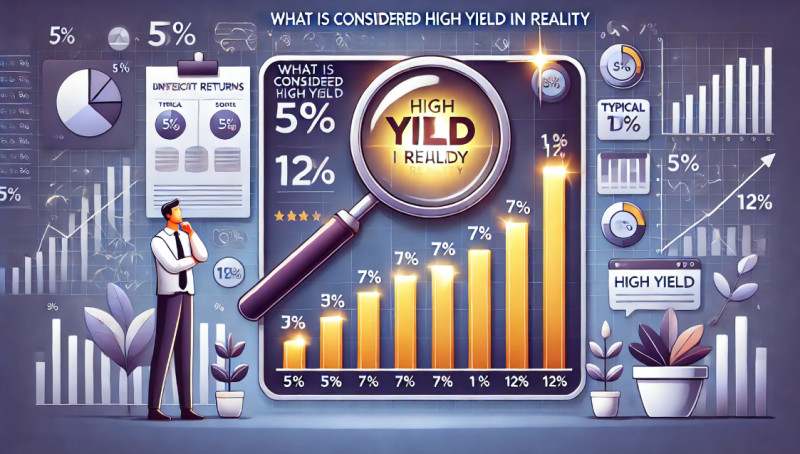
The number on a chart does not always tell the whole story. A 15% annual return sounds impressive, but if inflation was 10% in the same period, the real gain is only 5%. After a 13% tax bite, you end up with under 4%. What looks like “high yield” can become a modest increase. To fairly assess any fund’s potential, understand which metrics to use and account for external factors. Fund returns can also vary over time.
Absolute vs relative performance
• Absolute return — the raw figure: how much the instrument delivered over a given period. If a fund share cost ₽1,000 and a year later is ₽1,150, the absolute return is 15%. This metric is simple and visible, but meaningless without context.
• Relative return — performance versus a benchmark: an index, inflation, the central bank rate or alternative sources of return. A fund returning +10% may be impressive if the benchmark fell by 5%. Conversely, a +20% return is weak if the market rose 40%.
When making decisions, always evaluate both absolute results and performance relative to other available options. Only then can you judge whether a chosen instrument is truly effective.
Annual return vs cumulative return
Annual return is the average growth per year. For example, if a fund grows from ₽1,000 to ₽1,800 over 5 years, the average annual return (CAGR) is about 12.47% (compound‑interest basis). This metric gives a sense of growth stability.
Cumulative return is the total profit over the whole period. In the example above, it is 80% over 5 years. That figure can be misleading if presented without a yearly breakdown — a single very good year can distort perception even if performance was flat or negative the rest of the time. ETUIF investments are not always that simple.
You should look at both metrics: cumulative to understand how much the fund delivered in total, and annual to see how it performed over time.
How inflation and taxes eat into returns
Nominal returns do not equal real gains in purchasing power. Inflation acts like an invisible tax: money loses value, and portfolio growth can be insufficient to offset rising prices. If an instrument shows 10% return while inflation is 8%, the real growth is only 2% — and that is before taxes.
Taxes further reduce the result. For example, with a standard 13% tax on gains, the real return declines accordingly. If a fund pays dividends, those are taxed as well. Some ETFs are not registered in Russia, and income from them requires manual reporting to the tax authorities — that is an additional cost in time and money.
The optimal scenario is to use tax benefits (IIA — individual investment account, long‑term holding, individual deductions), choose funds that reinvest income, and minimize transaction costs. Without that, even a strong tool can become mediocre.
What counts as “high yield” — historical context
The threshold for high yield varies with the macroeconomic environment:
- 2000–2007: steady global growth. Yields of 15% p.a. were considered high.
- 2008–2009: collapse and panic. Any positive return was a good result.
- 2010–2019: era of low rates. US equities delivered around 12–14% p.a.; bonds 4–6%.
- 2020–2021: post-COVID surge, equity instruments returned 40–70% in a year — an anomaly, not the norm. Passive income methods underperformed.
- 2022–2023: geopolitics, volatility, inflation. Commodities rose, tech lagged. A realistic ceiling is 15–25%; anything above requires extra explanation and analysis.
Today, in an environment of unstable currencies, high policy rates and sanctions pressure, returns of 12–15% are considered good at controlled risk. Anything higher implies aggressive strategies with potential for sharp drawdowns.
High yield is not just a big percentage. It is a result net of inflation, taxes and one‑off spikes. It must be compared with risks and alternatives. It’s not the peak return at a rally but a steady long‑term performance. The focus should be on reliable balance, not the highest percent — that builds enduring financial results rather than a lucky streak.
Return vs risk: how to choose a fund for your risk tolerance
Each fund balances potential return and volatility. High yield often comes with deep drawdowns, while stability usually means moderate capital growth. Understanding the trade‑off helps avoid major mistakes and build a strategy matching your risk appetite.
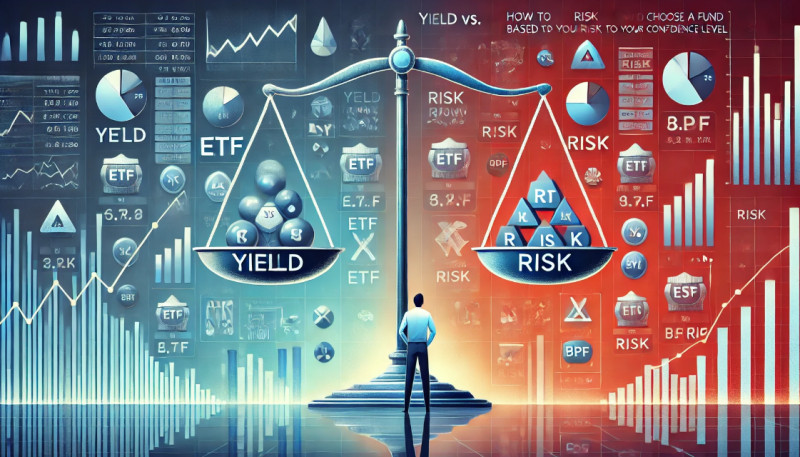
Direct view: aligning return and volatility
Risk should be quantified, not just felt. A key metric is standard deviation, which shows how much a fund’s value varies around its mean over a period. Higher standard deviation means larger swings: big profits are possible, but so are big losses. High‑dividend stocks require care and close attention.
To compare funds on a like‑for‑like basis, use the Sharpe ratio. It shows how many units of return a fund generates per unit of risk.
Formula: (Fund return – Risk‑free rate) / Standard deviation.
Example:
- Fund A: 15% return with a standard deviation 10%. Sharpe = (15 – 7) / 10 = 0.8
- Fund B: 12% return with standard deviation 6%. Sharpe = (12 – 7) / 6 = 0.83
Despite the lower absolute return, Fund B is more efficient — it delivers more return per unit of risk.
Grouping funds by volatility level
Low risk — stability with minimal drawdowns
- Bond ETUIFs and ETFs: mostly ruble instruments with moderate coupons.
Examples: Sberbank — MOEX Government Bond Index; VTB — Ruble Bond Market. - Money market funds: an alternative to bank deposits.
Yield 6–9% p.a., deviation under 3%, Sharpe above 1.0. - Suitable for savings, emergency cushions and first steps in the market.
Moderate risk — balance of return and stability
- Multi‑asset funds: combine equities and fixed income.
Examples: FinEx Multi Asset, VTB Balanced. - Dividend strategies: focus on stable payouts from large companies.
Examples: FXDV, Tinkoff Dividends. - Returns typically 10–16% p.a., standard deviation 6–10%, Sharpe 0.6–1.0.
- Versatile for many goals: from regular accumulation to passive income.
High risk — aggressive growth with potential drawdowns
- Technology sector funds: include fast‑growing companies. Examples: FXIT, VTBE.
- Emerging‑market funds: focus on rapidly developing but volatile economies. Examples: FXEM, Tinkoff New Economy.
- Returns can exceed 20–30% p.a., but the standard deviation is often 15% or higher.
- Sharpe ratios are rarely above 0.6, but upside potential is the largest.
- Suitable for investors willing to accept risk to accelerate capital growth.
How to read the risk‑return chart
Imagine a chart with volatility on the X axis and return on the Y axis.
- Bottom‑left: funds with minimal activity and low returns.
- Top‑right: strategies with high potential but sharp swings.
The goal is to find instruments as high and left as possible: maximum return for minimal volatility.
The higher a point above the diagonal “risk = return” line, the more efficient the fund — that is reflected in a high Sharpe ratio.
Choose for yourself, not for someone else’s goals
There is no perfect fund for everyone. Some need to preserve capital and slightly grow it. Others want to turbo‑charge their capital with full force. It’s important to understand: every strategy is a compromise. You can buy peace of mind but sacrifice upside. You can chase growth, but be prepared for a 30% drawdown or more.
The choice should be based not on last year’s pretty returns, but on an understanding of what will happen to your money in different market phases. Risk is not the enemy — it’s a tool if you know how to use it. ETF shares do not forgive negligence.
Critical mistakes when choosing high‑yield funds
The desire to get maximum return from capital is natural. But high yield often becomes a trap that many retail investors fall into. Instead of analysis and calculation, people make impulsive decisions based on illusions. Below are key mistakes that regularly undo efforts and stall portfolio growth.
Blind reliance on past returns
A common mistake is choosing a fund based on the last year’s chart. A 40% or 70% rise breeds confidence and the illusion of stability, but it can be a one‑off spike tied to a local event: a merger, a rate shift, or a technical rebound after a sell‑off.
Past performance does not guarantee future results. Funds showing peak profits over a short interval are particularly risky. Such spikes more often indicate excessive volatility than a stable strategy.
Reliable tools are not those that shot up last month but those that stay stable over a 3–5 year horizon. Analyse not only percentage gain but drawdown depth, frequency of corrections, and reactions to external shocks. Look at the Sharpe ratio, standard deviation and portfolio structure — not a headline “+60% this year”.
Ignoring currency risk
A fund can be denominated in rubles but contain foreign assets, or denominated in dollars but focused on emerging markets. Currency movements directly affect returns. Dollar strength can erase gains; a falling ruble can create an illusion of growth. BPIF investments demand focus and attention.
Without a clear assessment of the currency component, you can end up with a portfolio that rises nominally but loses real purchasing power. This is especially critical for short horizons: if you plan to lock in gains in 6–12 months, exchange‑rate volatility can wipe out margins.
When choosing a fund, analyse the quote currency, asset mix and country risk exposure. Don’t take a rising dollar as an unconditional plus — consider how it affects your specific portfolio.
Neglecting tax consequences
All profits are taxable. Even double‑digit growth can shrink significantly after personal income tax. This is especially true for foreign funds where double taxation can occur: withholding tax at source and tax when reporting income in Russia.
Also note: funds that pay income as dividends may limit the ability to use certain tax benefits on an IIS (individual investment account). ETFs not registered in Russia do not fall under automatic tax reporting and require a manual declaration. That’s a time and money cost.
Ignorance of tax details can nullify even an excellent strategy. Choose instruments based not only on gross yield but on what remains “in your pocket” after all deductions. Use deductions, IIS, tax residency and other legal measures to reduce costs.
Chasing hype
Top themes — AI, crypto, biotech, green energy — attract massive flows. But they also bring scams, bubbles and marketing traps. Passive‑income methods require careful verification. Oftentimes, funds tied to hype segments appear when the main growth wave has already passed. Investors buy at the peak, hoping for continuation and get -30% in the next quarter.
A flashy name doesn’t guarantee quality assets. Hype is more packaging than substance. Check the structure: if a fund contains mostly speculative assets without a dividend base, with unprofitable companies and heavy dependence on venture capital, it’s a lottery, not a strategy.
Don’t jump in just because “everyone’s talking about it.” Professionals enter before the noise and exit during it. Most newcomers do the opposite.
Mistakes in choosing high‑yield funds almost always come from a lack of analysis, overestimating short‑term dynamics and underestimating risks. To avoid burning out chasing profits:
- Evaluate returns in the context of volatility and the Sharpe ratio;
- Account for currency impact, especially for funds with global assets;
- Calculate not only gross profit but taxes — including IIS, personal income tax and deductions;
- Ignore fashions. Check what’s inside. Hype fades, drawdowns remain.
A high‑yield fund is not a casino win but a mechanism that must be managed. Knowledge is the filter between random success and systematic results.
Conclusion
In this article, we examined funds and high‑dividend shares. A portfolio built with funds can be a steady income generator or a constant source of disappointment. The difference lies in understanding which instruments fit specific goals. There is no universal choice. There is context: financial priorities, psychological tolerance for drawdowns and the investment horizon.
Which funds suit whom
Conservative approach
Those who prioritise predictability need low‑volatility solutions with stable cash flows. Suitable are bond‑heavy funds, debt index products and money market instruments.
Average returns — 7–10% p.a.; minimal deviation; potential drawdown no more than 5–7%.
Goal: capital preservation, inflation protection and an alternative to deposits.
Balanced approach
For those who want higher returns but are not ready for sharp swings. Ideally, dividend funds and blended products (debt + equity) with moderate geographic exposure.
Volatility 7–12%, returns up to 15–18% p.a. The burden is shared between fixed-income and growing, profitable companies.
Goal: gradual accumulation, cash flow and protection against currency/market shocks.
Aggressive approach
Maximum potential — maximum risk. Funds focused on emerging markets, tech, commodities and transformative global innovators. Standard deviation can exceed 15–20%, drawdowns of 30–40% are possible, but successful entries can multiply capital. These instruments belong in the high‑risk portion of a portfolio, not the core.
Goal: rapid growth, long‑term capitalisation and boosting the return component of the portfolio.
High yield = higher risk. Always. Any instrument promising returns at least twice bank rates demands full readiness for volatility. There are no miracles. High returns come with high probabilities of corrections. Drawdowns are part of the path. Funds capable of +30% p.a. may fall 25% in a quarter. Not everyone can withstand such swings psychologically, even if the ultimate result beats the market.
Real return is not the peak number on a chart. It is what you managed to hold and lock in.
Mistakes begin when someone takes on more risk than they can bear. Don’t copy someone else’s structure. Even if a strategy made 100% for someone else, it may be unacceptable for your comfort level.
No diversification — vulnerability. With it — resilience. A portfolio without allocation is like a house on a single foundation. One market crash and everything collapses. Minimum three elements:
- Stable base — low‑volatility funds;
- Growth layer — segments with accelerated upside potential;
- Protection — anti‑crisis instruments (gold, short bonds, currency funds).
Optimal structure is not a mathematical formula but a logical assembly of income sources with different characteristics. The more independence between components, the higher the resilience to external shocks.
Plus — regular rebalancing. Check allocation once a quarter and restore target weights if needed. That lets you buy the beaten down and sell overheated automatically. ETF shares are a form of investing that does not tolerate haste.
Choosing a fund is choosing not only numbers but a strategy for behavior in every market phase. Strong results are built not on a perfect entry but on a robust model that accounts for everything: from taxes to drawdown depth. High‑yield instruments are available to anyone, but they turn capital into real growth only when supported by logic, not emotions.


 Back to articles

