



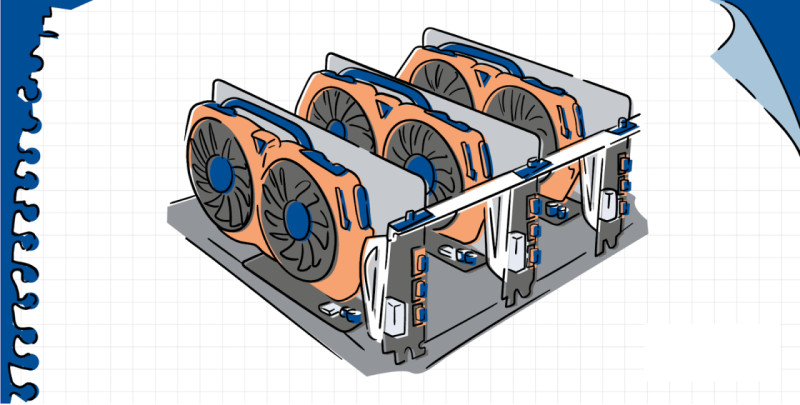
 Mining farm
Cryptocurrencies do not enter circulation through issuance like traditional money. There is no central authority or organization that can release new units of currency if necessary. The process of introducing coins into circulation is pre-programmed in the code of each digital currency.
One of the most well-known and sought-after methods of putting digital coins into circulation is mining. However, as this activity has become more popular among users, the process has become increasingly complex, making it impossible to mine on a regular PC.
As a result, users began combining multiple devices to create mining farms capable of producing cryptocurrency faster and more efficiently. These are the subject of this article. More information about the mining process, its stages of development, and prospects can be found in the article “Mining.”
Brief history of mining farms
Before we examine what a mining farm is and how it works, let us discuss what led to its emergence. Mining is the process through which new units of a particular digital currency are introduced into circulation, and for some currencies, no alternative method has yet been developed.
The main function of mining, however, is to financially incentivize users to ensure the proper functioning of the blockchain. Miners verify all transactions and add them to blocks, which are then linked together into a continuous chain.
For each mined block, users receive a reward in the form of new digital coins. The first miner was the creator of the first cryptocurrency, Satoshi Nakamoto. In the early days, mining was done for entertainment, as there was little interest in digital currencies.
Moreover, cryptocurrency could be mined without any special equipment, simply by using a personal computer or laptop. At that time, the rewards were enormous by today’s standards — 50 BTC for each mined block. Users often did not know what to do with the cryptocurrency and spent it on small purchases or sent it to one another.
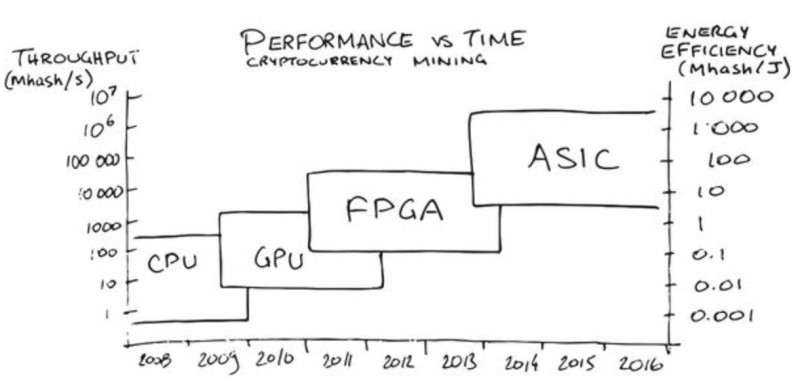 The illustration shows how mining devices have evolved over time, along with their performance and energy efficiency.
In the first year after Bitcoin’s launch, the number of miners worldwide was only in the hundreds. However, within a short time, it quadrupled as interest in blockchain technology and cryptocurrencies grew.
At the same time, cryptocurrency exchanges began to appear, allowing digital coins to be exchanged for real money. This further fueled interest in mining, while the price of Bitcoin began to rise.
Simultaneously, the difficulty adjustment algorithm embedded in the code of the first digital currency began to operate automatically. Mining on a CPU became too difficult, prompting miners to switch to graphics cards, which were much more productive. Eventually, users started combining multiple graphics cards into a single device or connecting several devices together, thus creating the first farms.
Basics of mining farms
Now that we understand the prerequisites for the emergence of mining farms, let us examine in more detail what they are and how they operate. Once cryptocurrency mining began to be performed using one or more graphics cards, another “revolution” took place in this sphere, leading to the appearance of new devices.
These devices are called ASIC miners, and they differ in that they are highly specialized machines designed specifically for mining digital currencies. In the modern sense, a mining farm is understood to mean the combination of several such devices.
Small farms consisting of several units can be set up at home. However, there are also entire data centers in which hundreds or even thousands of devices are brought together in one location to process data. The more devices there are, the greater their combined computing power and, consequently, the higher the chances of receiving a reward.
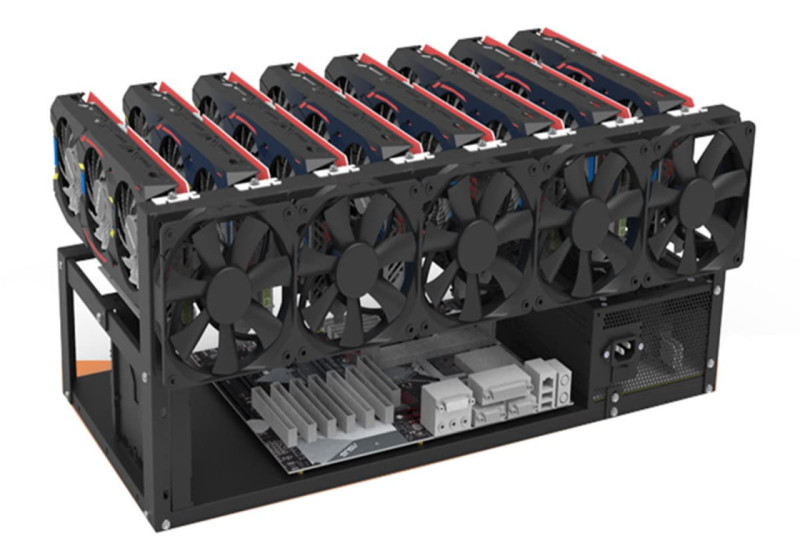 The image shows a small GPU farm consisting of eight graphics cards
Depending on the number of devices, mining farms can have different configurations and appearances. However, the main purpose of all of them is to combine computing power in order to solve blockchain tasks more efficiently and add new transactions to blocks.
The combination of several devices is necessary because, in solo mining, the rate of coin production is significantly lower, and, as a result, the chances of receiving a reward are also lower. Depending on whether the devices belong to a single person or to several, the following types of farms are distinguished:
· Solo farm is a mining system configured to mine cryptocurrency independently of other devices. All equipment in this system belongs to a single owner. In this case, however, the owner must have a large number of available devices.
· A pool is a combination of several miners and their devices, including their own farms, for joint mining and reward sharing. The reward is distributed among all participants in such a group.
Mining farm explained in simple terms
Let us take a closer look at how a mining farm is structured and what components it includes. Regardless of its size or configuration, any mining farm consists of certain essential elements, which are as follows:
- Equipment is the core element of any farm. As mentioned earlier, the type of equipment can vary, but more modern and powerful hardware offers higher chances of solving tasks, adding a transaction to a block, and therefore receiving a reward.
- Central Processing Unit (CPU) is needed to coordinate the operation of the farm and all its components. It plays an important role in maintaining the system’s functionality.
- Motherboard is the platform on which all components of the farm, including mining hardware, are installed. It enables communication between different parts of the farm and ensures their coordinated operation.
- Power systems – any farm requires a large amount of energy to operate. High-capacity power supplies provide the entire farm with the necessary electricity.
- Cooling systems – due to intensive operation, farms generate a significant amount of heat. Cooling systems are necessary to maintain an optimal temperature for stable hardware performance.
- Internet access is required to connect the farm to the blockchain of a specific cryptocurrency, transmit mined blocks, and perform other related operations.
- Software is a special program needed to configure and link all devices for joint operation. They ensure communication between the farm and the network of the chosen cryptocurrency and manage task execution.
- Wires and connection cables link all components of the farm together. This category includes Ethernet cables, USB ports, and other connectors, with fire safety being the key requirement for their use.
Mining farm operation
We have already determined what a mining farm is and what its main components are. Now it is time to understand how it operates and what tasks it performs. Naturally, its primary purpose is the actual mining of cryptocurrency, so let us take a closer look at how this process is carried out.
At the core of every digital currency lies blockchain technology. This means that all transactions conducted with cryptocurrency are processed not by a single central processor, but by an entire network of independent devices. After verification, transactions are grouped into blocks, which are then linked together to form a chain.
The essence of mining is that in order to verify transactions and combine them into blocks, complex mathematical calculations must be performed. A person cannot do this manually, so special devices are used for this purpose.
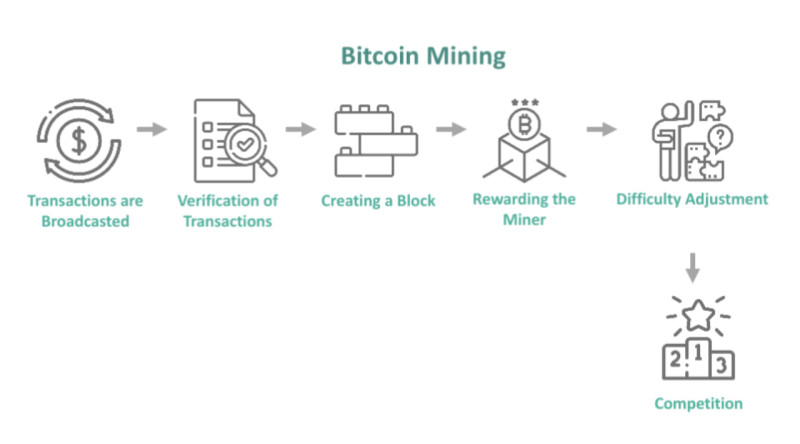 The illustration demonstrates the key essence of mining
 The owner of the equipment that finds the correct solution faster gains the right to add a new block to the chain and receives a reward. As the number of miners grows, the difficulty of mining cryptocurrency also increases. Consequently, mining farms are used to improve the efficiency of this process.
The time required to mine a single block varies across networks. For example, in the Bitcoin blockchain, it takes 10 minutes. This means that a reward can be obtained every 10 minutes, but due to the high level of competition, it is difficult for the same farm owner to repeat this process continuously.
The performance and efficiency of a mining farm depend on several factors:
• Equipment performance – the higher this parameter, the more effectively the farm will operate. However, there are certain nuances: the newer and more powerful the equipment, the more expensive it is, meaning a significant initial investment may be required to build a farm.
• Mining difficulty – this varies across different blockchains. As a general rule, the more miners (or mining devices) join the process, the more difficult mining becomes, and the smaller the reward size.
True cost of setting up mining farm
Before estimating the potential monthly income from a mining farm, it is important to assess the initial capital required for its setup. The size of the initial investment has a significant impact on potential profits, as the quantity and quality of equipment may vary.
The cost of any mining farm includes several key components:
1. The price of equipment (ASIC miners, power supply and cooling systems, motherboards, and other devices);
2. Repair and maintenance expenses;
3. Cooling costs, especially during warmer months;
4. Electricity costs (farms consume a considerable amount of power, so access to preferential tariffs would be an advantage).
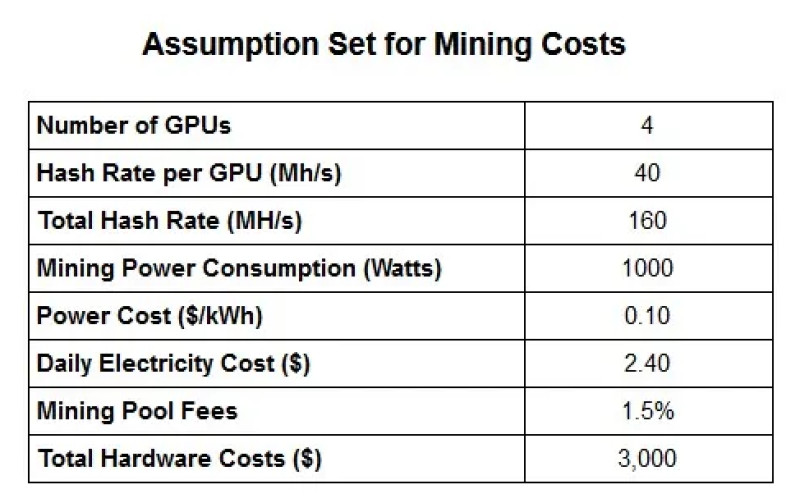 The table shows an approximate cost calculation for a farm with four devices
Naturally, one of the largest expense items is equipment purchase. More advanced and powerful devices are more expensive. The amount of equipment also depends on which cryptocurrency the user plans to mine. A single ASIC miner can mine several coins that share the same algorithm.
Equipment costs vary by type: the price of video cards ranges from $500 to $2,000. Since several units are needed for a farm, such a setup may cost up to $12,000. As for ASIC miners, prices range from $1,000 to $10,000 depending on performance.
One should also consider the cost of mining software. While some programs are free, others provide trial versions followed by a paid subscription. Electricity expenses take up the largest share of ongoing costs.
Electricity tariffs differ by country but calculating them is straightforward if you know the device’s energy consumption. A single video card requires 150–300 W, meaning a farm of six video cards will consume around 1,800 W. An ASIC miner consumes from 1,000 to 3,000 W.
When choosing equipment, it is important to consider energy efficiency and possible ways to reduce consumption. However, in some countries, miners are prohibited from using preferential tariffs. Alternative energy sources, such as solar panels, can also be used.
Purchasing mining equipment has one key advantage: it can later be resold on the secondary market to recover part of the investment. This option is unavailable with cloud mining, where all equipment is rented.
Monthly income from mining farm
With a general understanding of setup and maintenance costs, we can now look at how much one might earn from mining cryptocurrency using a farm.
Several factors, beyond the number of devices or their performance, affect potential income:
• High volatility of digital currencies – one of crypto’s key characteristics is sharp price fluctuations within short periods. This makes it impossible to predict exact profits from mined coins.
• Mining difficulty – mining is possible only on networks using the PoW algorithm. However, nearly every cryptocurrency has built-in rules that automatically increase mining difficulty as the number of miners grows, ensuring overall network balance and steady emission.
• Electricity costs—miners can reduce expenses by relocating to regions with lower tariffs or by using alternative power sources.
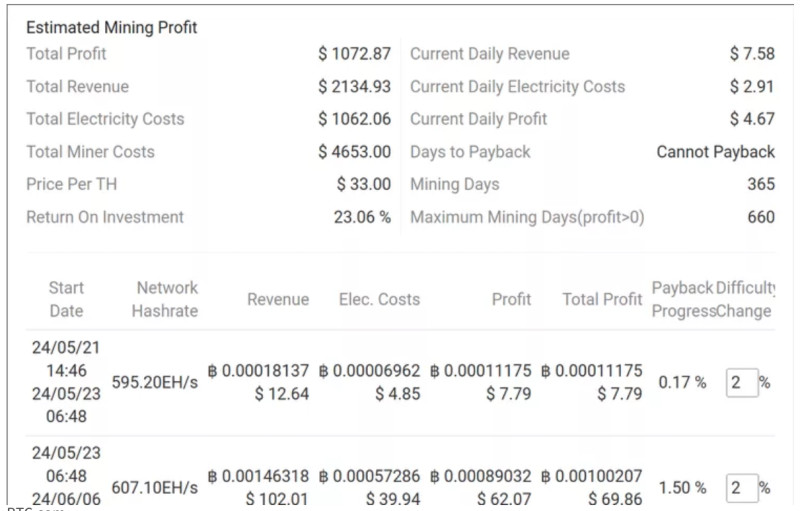 The image shows a calculation of potential mining income, accounting for all expenses
Before estimating profits, it is essential to calculate the payback period, meaning how long it will take for the mining farm to recoup the initial investment. On average, this period ranges from 1 to 1.5 years, but it can extend to 2–2.5 years depending on equipment costs.
Furthermore, profitability differs between farms based on video cards and those using ASIC miners. For example, a large farm with 11 ASIC miners can mine 0.003352 BTC daily, or 0.1 BTC monthly, and about 1.2 BTC annually (excluding electricity costs).
At a Bitcoin price of about $61,000, this translates to roughly $61,000 per year or about $6,000 per month. These are approximate calculations, as Bitcoin’s mining difficulty can change monthly. For other cryptocurrencies, the figures will also vary, and in most cases, they are significantly lower.
Mining farm in apartment
Now that we know what components a mining farm consists of and how it works, it is time to find out whether it is possible to set up a farm right at home, in an apartment, and most importantly—whether it is legal. Let us look at the main difficulties one may face when organizing a mining farm in a residential space.
The first challenge is noise. Mining farms generate a considerable amount of noise, which can cause dissatisfaction among neighbors. To address this issue, it is important to plan soundproofing in advance. For instance, there are special enclosures equipped with additional layers of sound-absorbing materials.
The next problem is cooling. Apart from noise, farms emit a significant amount of heat. To deal with this, the equipment can be placed on a balcony where it will be naturally cooled (except during warm seasons), or special cooling fans can be used.
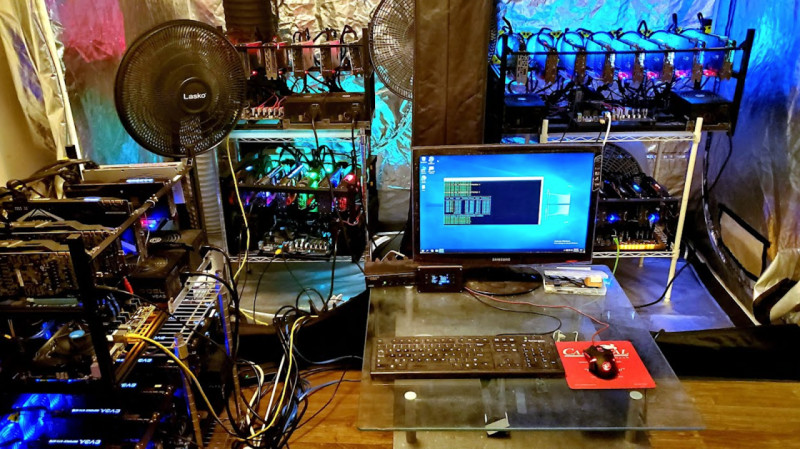 The illustration shows how a mining farm can be arranged in a typical apartment setting
The third and most complex issue is the legal aspect. On the one hand, mining is legal in many countries. On the other hand, setting up farms may raise concerns from government authorities, especially when they are located in residential premises.
Firstly, mining farms consume a large amount of electricity, which can overload power grids. This may lead to accidents that leave not only the entire apartment building but also potentially an entire neighborhood without electricity. In such cases, miners may be held liable.
Secondly, miners often do not pay for electricity at business rates but instead place farms at relatives’ or friends’ properties with discounted tariffs. If the electricity supplier discovers a mining farm using a preferential rate, it has the right to recalculate the consumed energy at the highest tariff and issue additional bills.
Thirdly, mining is considered an activity subject to taxation. If done solo and on a small scale, one can register as self-employed and pay minimal taxes. However, if a farm is used and production volumes increase, it is recommended to switch to another taxation regime, such as registering as an individual entrepreneur.
Mining hotels
Instead of dealing with the numerous challenges of setting up a mining farm at home, one can make use of mining hotel services. Let us take a closer look at what they are and how they operate.
A mining hotel is a specially equipped facility with a ready-made infrastructure where users can place their farms in rented spaces. In other words, the miner installs their own equipment in areas specifically designed for this purpose.
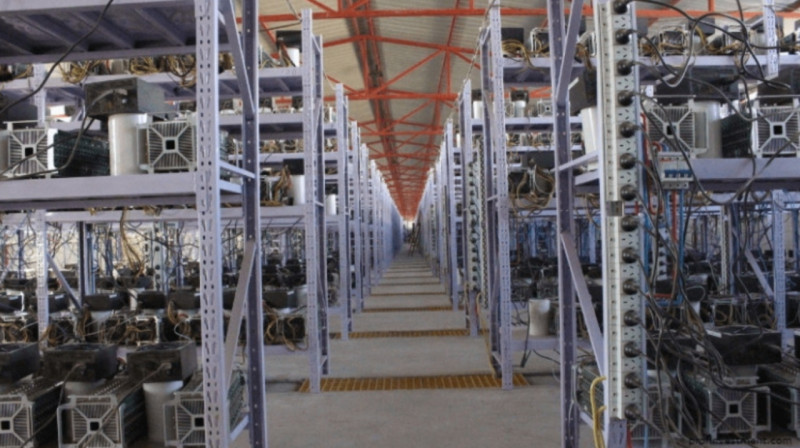 The illustration shows the interior of a mining hotel
All that is required from the user is to purchase the devices themselves, such as video cards or ASIC miners. All other components of the farm are provided by the mining hotel. The main services offered by such organisations include:
- Renting out space for installing cryptocurrency mining equipment;
- Guaranteed and stable power supply;
- Reliable Internet connection;
- Cooling and ventilation systems, including air filtration and humidity control;
- Fire protection with automatic fire extinguishing systems;
- Technical support and equipment administration by technical staff;
- 24/7 security and video surveillance.
Additional services offered by such data centers may include equipment repair and maintenance, server rental, and other hosting services. Furthermore, the hotels themselves may also offer mining equipment for rent.
Naturally, all services of a mining hotel are paid, but for miners the main advantage is that they do not need to worry about operational matters and can focus entirely on their primary goal—cryptocurrency mining. Moreover, most of these centers operate legally, which means users will not face any legal issues.
Mining hotels are typically equipped with racks where farms belonging to different users renting space in the facility are installed. Service costs include the rent itself (on average from $30 to $100) plus the cost of electricity, which is billed separately depending on the consumption of each specific farm.
From all of the above, it is clear how many advantages there are in placing a farm in a specially equipped facility. A brief comparison between using a mining hotel and setting up a farm at home is presented in the table below:
| Parameter | Mining Hotel | Home Farm |
| Soundproofing | Available | Requires installation |
| Cooling and ventilation systems | Available | Requires installation |
| Stable power supply | Available | Possible outages due to overload |
| Internet connection | Reliable (can use several providers simultaneously) | May be unstable (weak signal and other reasons) |
| Legality | Fully legal activity | Not always entirely legal activity |
Conclusion
In this article, we have examined the key aspects of creating and operating what is known as a mining farm. It is a combination of several computing devices aimed at the rapid and efficient performance of mining tasks, namely the verification of transactions and their addition to blocks that are then combined into a blockchain.
The need for mining farms arose after a large number of users began to mine cryptocurrency. As interest in the process grew, so did its difficulty, making it impossible to mine using a regular computer, as was the case initially.
Today, mining farms use specialized high-power and high-performance equipment. However, in addition to these devices, each farm also requires other components: a power supply and cooling systems, software, an Internet connection, and more.
While all of this can be arranged at home, it is not particularly safe and may lead to serious consequences, including administrative or even criminal liability. There is, however, an alternative—mining hotels, which provide all the necessary infrastructure for placing the equipment.


 Back to articles

