



Mining of digital currencies can be carried out in different ways: using processors, graphics cards, or ASIC miners. Some of these methods are already considered outdated and inefficient. However, such an assessment must take into account not only the method of mining itself but also several other factors.
For example, the methods and devices that may not be suitable today for Bitcoin mining still work perfectly well for mining other digital coins. At the same time, they may even have advantages compared to seemingly more advanced technologies and equipment.
It is one of these methods of cryptocurrency mining, namely mining with graphics cards, that we will discuss in more detail in this article. More information about what the mining process of digital currencies is, how it works, and how one can earn more profit from it can be found in the article “Mining.”
Brief history of mining
Mining is the process by which new units of a particular cryptocurrency are generated. However, this does not mean that they need to be searched for somewhere or extracted from something. Miners ensure the functioning of the blockchain by verifying all operations in it and combining them into blocks, and for this, they receive rewards in the form of new digital coins.
Mining appeared together with the first digital currency — Bitcoin, and the first miner was its creator, Satoshi Nakamoto. In the early stages, mining coins was very simple; the processing power of a laptop or desktop computer was sufficient, and this was called CPU mining.
However, over time, the popularity of digital currencies and user interest in them began to grow. Approximately one year later, the first cryptocurrency exchanges appeared, where digital money could be exchanged for real money. This attracted more users to cryptocurrency mining.
At the same time, the process of automatic mining difficulty adjustment was launched, which was built into the code of the cryptocurrency itself. Literally a year or a year and a half after the emergence of the first digital currency, people realized the real value of cryptocurrency, and the first mining farm appeared.
A mining farm is a combination of several mining devices in order to achieve greater processing power and, consequently, higher mining efficiency. It was during this period that graphics cards began to be used, and we will discuss them in more detail in the following sections.
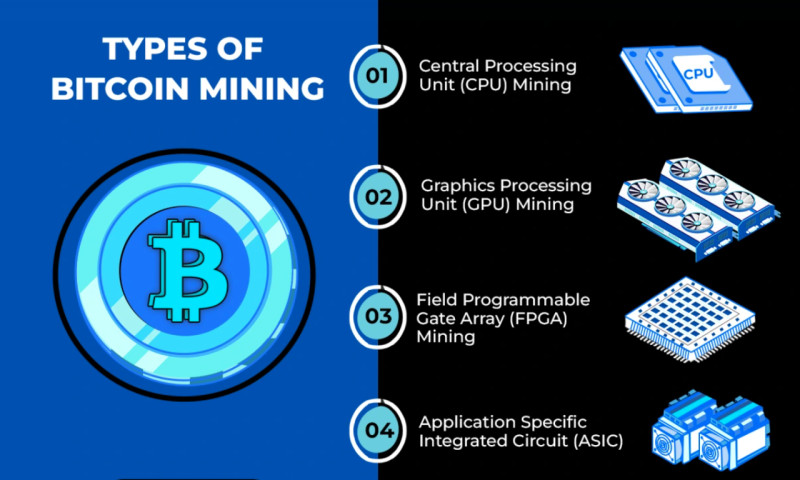
The transition to graphics cards was a breakthrough in mining because, first of all, even one graphics card was much more powerful than the processor of a regular PC, and second, one motherboard could accommodate four or more graphics cards. Thanks to this, CPU mining was immediately pushed into the background, and GPU mining emerged.
However, the improvement of mining devices did not stop there. Graphics cards were later replaced by even more powerful and productive ASIC miners. These are highly specialized devices that demonstrated much greater energy efficiency and higher profitability compared to GPU mining.
Closer look at graphics cards
Before figuring out how mining with graphics cards is carried out, let us first understand what they actually are and what they are intended for. In reality, graphics cards are not specialized equipment for cryptocurrency mining; they were simply adapted for this purpose because of their high performance compared to ordinary processors.
A graphics card, or GPU (Graphics Processing Unit), is a component of a computer designed to process and output images to a monitor. In addition, graphics cards perform certain video operations and some computational functions.
Graphics processors are an integral part of modern computers. Without them, we would not be able to watch films, play games, or work with graphic software. All graphics cards can be divided into two major categories:
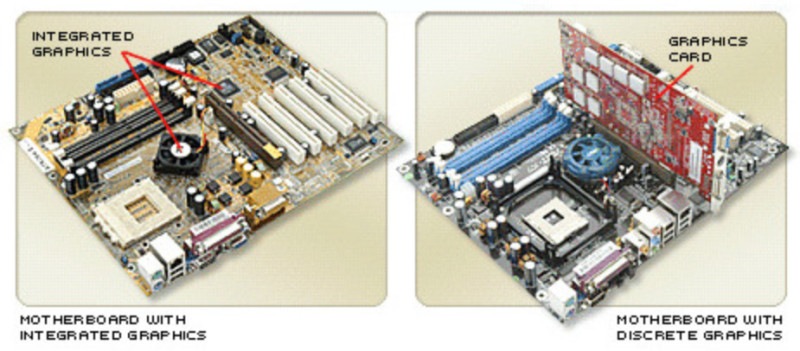
- Integrated — built into the PC. It appears as a chip integrated into the processor. It is simply one of the computer’s components and is suitable for performing the most basic tasks.
- Discrete — a separate device that can be connected to a PC. It has its own components, such as power supply systems, cooling systems, and connectors for connection to the computer.
A brief comparison of integrated and discrete graphics cards is presented in the table below:
| Parameter | Integrated Graphics Card | Discrete Graphics Card |
| Appearance | A chip built into the motherboard or processor | A separate device connected to the motherboard |
| GPU | Absent | Has its own graphics processor |
| RAM | Uses system memory | Has its own video memory |
| Power Consumption | Lower | Higher |
| Computational Power | Quite low | High |
What other tasks can graphics cards perform, or rather, for what other purposes can they be used apart from those mentioned above? Let us list more areas of their application:
- Graphic design;
- 3D modeling;
- Data processing and analysis, including the use of cryptography;
- Virtual reality;
- Simultaneous operation of several applications or connection of multiple monitors to one PC.
When choosing a graphics card, one should proceed from the individual needs of the user and his or her goals. As we can already see, graphics cards help to cover a rather wide range of user requirements, which is perhaps the reason why they began to be used for the mining of digital coins.
Beginning of GPU Mining: who and when
We have already established that the process of mining digital currencies has been constantly evolving. This development led users to shift from CPU mining to mining with graphics cards. Let us take a closer look at how this transition took place.
It is believed that the first graphics card-based mining farm was assembled by the company ArtForz in July 2010. From that moment, mining began to move towards a commercial foundation. Around the same time, mining pools started to appear, representing groups of miners working together as an alternative to building a farm.
One of the most well-known pools, called Slush’s pool, was created by a Czech programmer in 2011 and is still operating today. In the year it was established, the pool’s power reached 10 GH/s, which now seems extremely low compared to today’s performance levels exceeding 12.82 EH/s.
In that same year, 2011, the Bitcoin exchange rate grew rapidly without pullbacks, allowing miners to earn substantial profits. This led to a massive surge in demand for graphics cards. However, just as in the transition from CPUs to GPUs, the growing number of miners resulted in an increase in mining difficulty.
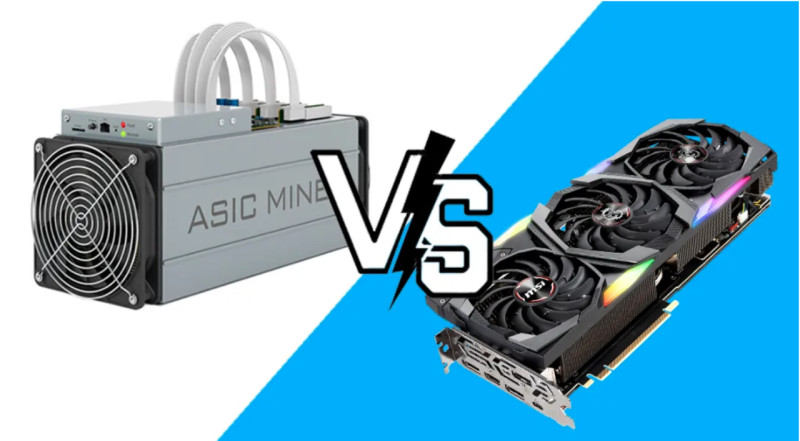
As a result, the first ASIC miners appeared in 2012. These were highly specialized devices with much greater power than graphics cards. From that point, Bitcoin mining with GPUs began to fade into the past, as it became inefficient.
Nevertheless, the cost of ASIC miners was several times higher than that of graphics cards, so not everyone could afford to purchase even a single unit, let alone several. At the same time, as interest in digital currencies grew, new coins began to appear that could still be mined with graphics cards.
Altcoins mining with graphics cards
The first altcoin, that is, an alternative coin to Bitcoin, was Litecoin. It was developed using the source code of the first cryptocurrency, which is why it is often referred to as a fork of Bitcoin. A new mining algorithm called Scrypt was introduced, and it was used for mining Litecoin.
Bitcoin, on the other hand, relies on a different algorithm called SHA-256. The key difference between these two algorithms is that Scrypt requires much lower hash power. This means that coins could be mined stably while using fewer resources, making it possible to mine even with “weaker” hardware.
Later, in 2013, Dogecoin was launched as a meme coin, originally created for fun. However, this cryptocurrency quickly gained massive popularity among users and continues to remain relevant to this day. Dogecoin could also be mined using graphics cards with the Scrypt algorithm.
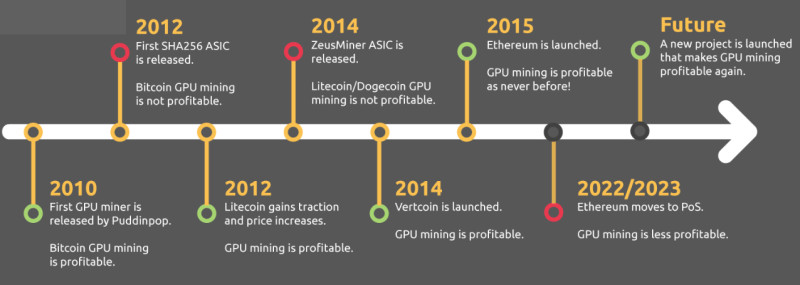 The illustration demonstrates a brief history of using graphics cards for altcoin mining
In 2014, several more digital currencies were launched, the most well-known being Monero and Vertcoin. With the introduction of these new cryptocurrencies, miners once again had the opportunity to mine coins using graphics cards, though this time with other algorithms.
In 2015, Ethereum was introduced, a digital currency that still ranks second among cryptocurrencies in terms of market capitalization. The development of Ethereum “breathed new life” into GPU mining, allowing users to generate substantial profits for an entire year.
At present, however, Ethereum mining has become impossible, as the blockchain switched from its former consensus algorithm, PoW (“Proof-of-Work”), which is also used in the Bitcoin chain, to PoS (“Proof-of-Stake”). This new algorithm is more energy efficient because it does not require specialized hardware. As a result, GPU mining has once again become less profitable.
Mining with graphics cards: what is needed?
Now that we already have an understanding of what graphics cards are and what functions they perform, we can discuss which devices are suitable for mining, how much they cost, and what additional equipment may also be required.
Apart from purchasing a graphics card or several cards, special software will be necessary. In addition, it will be important to set up a wallet for storing mined coins. There are two main groups of wallets:
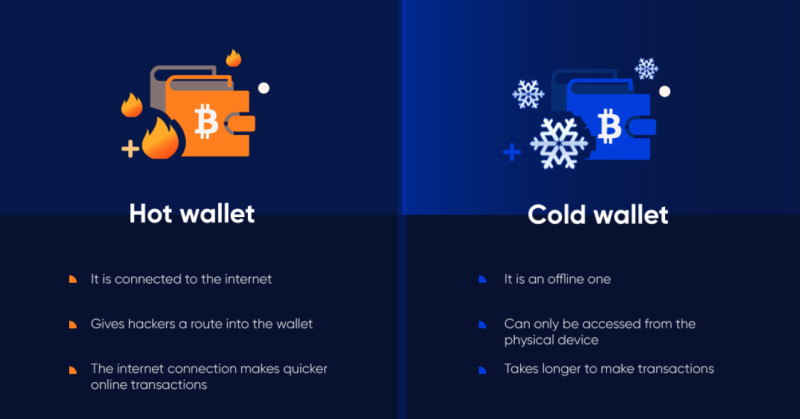
- Hot wallets – these are connected to the Internet, which allows the user to quickly access their coins. However, such wallets are more vulnerable to hacker attacks. They are available in the form of mobile applications, online services, and other options.
- Cold wallets – these are special devices similar to flash drives that are not connected to the Internet. Such devices are more expensive but provide safer storage of cryptocurrency.
Which graphics cards are suitable for mining digital currencies? The most optimal options are considered to be AMD or Nvidia. The cost of such cards varies depending on their specifications, starting from USD 300–350 and reaching as high as USD 1,000–1,500.
Potential income depends on the power and performance of the graphics card, so saving on this component is not recommended: the lower the price, the lower the computational capacity. Furthermore, in most cases, one graphics card will not be enough; a mining farm of four or more devices will be required.
The next preparatory step is choosing and installing mining software. The most popular programs are Bitminer and BFGMiner. Without such programs, it is impossible to coordinate the hardware and carry out the mining of digital coins.
Another important expense to take into account is the cost of electricity needed for mining. If the user has access to electricity at preferential rates or from renewable sources, this can significantly reduce costs.
Process of building GPU-based mining farm
As already mentioned, in order to mine effectively with graphics cards and generate income, one device will not be enough. Therefore, it is necessary to organize a mining farm consisting of several units. At the same time, multiple graphics cards are far from the only equipment required for a farm.
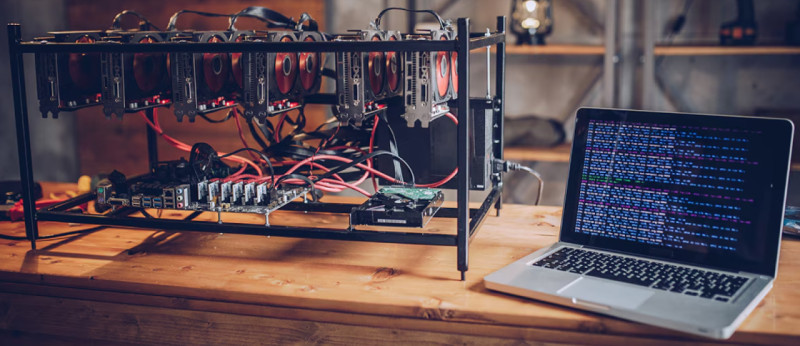 The illustration demonstrates the assembly of a home-based mining farm with graphics cards
To build a mining farm, the following components are required:
1. Graphics cards – a farm requires at least four devices, and in some cases, six or even eight graphics cards are used. It is important to pay attention to their functionality: it is better to purchase fewer cards of higher quality and better performance than to focus only on quantity.
2. Power supply unit – it will provide stable electricity to the entire system. Each graphics card consumes a certain amount of energy, so it is necessary to calculate the total electricity demand for the farm.
3. Frame for mounting the equipment – it can be made independently from wood or aluminum. All components of the farm will be installed in this frame.
4. Proper room conditions – the room must be well-ventilated. Graphics cards generate a lot of heat during operation, so to prevent overheating, it is recommended to use additional cooling solutions such as fans or air conditioners.
5. Connection to a personal computer – the entire construction must be connected to a PC, which includes several other essential elements such as a processor, hard drive, RAM, and so on.
To avoid the hassle of arranging a room for placing a mining farm, one can also use the services of a mining hotel. This is a specially equipped facility with all the necessary infrastructure where users can place their devices for a fee and gain remote access to them.
Income from GPU mining
Calculating the income that can be generated from GPU mining is not particularly difficult. This is especially true today, given the large number of online calculators that can provide results within minutes: you simply enter the technical specifications of your device, and the service generates an estimate.
As already mentioned, mining Bitcoin with graphics cards at the present time makes little sense, since GPUs cannot compete with the more powerful and modern ASIC miners. However, there are other digital currencies that can still be mined with GPUs.
Before calculating potential income, it is necessary to account for all expenses, including the cost of building a mining farm, electricity bills, repair and maintenance costs of the equipment.
It is also important to understand that a mining farm requires a certain period to pay for itself, and only after this point does it begin to generate profit. On average, the payback period for a GPU mining farm ranges from several months to a year.
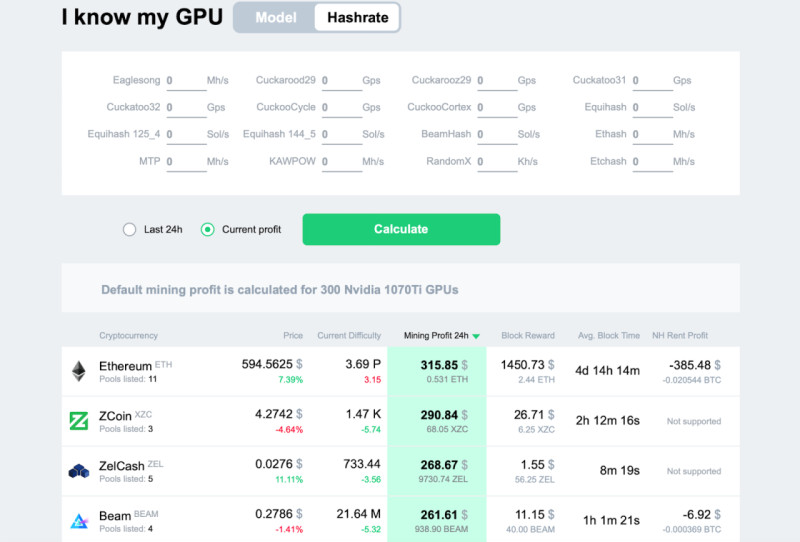
The choice of cryptocurrency to be mined also has a significant impact on potential income. Without doubt, the largest income could be earned from Bitcoin mining due to its high market value, but graphics cards cannot provide meaningful competition to ASIC miners.
Therefore, it may be more profitable to focus on other coins that are easier to mine, allowing miners to produce them in greater quantities and increase profit as a result. At the same time, it is important to remember the high volatility of cryptocurrencies, meaning that their prices can change significantly within short periods of time.
If we compare the potential monthly income from mining different digital currencies, the figures look as follows: Litecoin brings on average USD 800–1,200, Bitcoin Cash USD 1,000–1,500, and Monero USD 700–1,000. If hardware capacity allows, it is also possible to mine several coins simultaneously.
GPU mining: advantages and disadvantages
Taking into account all the information discussed earlier, let us examine the key advantages and disadvantages of GPU mining. Despite the growing popularity of ASIC mining, graphics cards still hold strong positions in certain areas and offer the following benefits:
- Versatility. Graphics cards can be used to mine various digital currencies, unlike ASIC miners, which are highly specialized devices designed for mining only one specific coin.
- Flexibility of use. Building on the previous point, miners can switch between different coins depending on profitability at a given moment or mine several coins simultaneously to diversify their portfolios.
- Resale value. Graphics processors retain their market value and can be resold profitably. This is because such devices can be used for many purposes beyond mining, for example, for gaming or video editing.
- Accessibility. The cost of graphics cards is significantly lower than that of ASIC miners, making them more affordable for a wider range of users. In addition, graphics cards are easy to purchase since they are available in almost any computer hardware store.
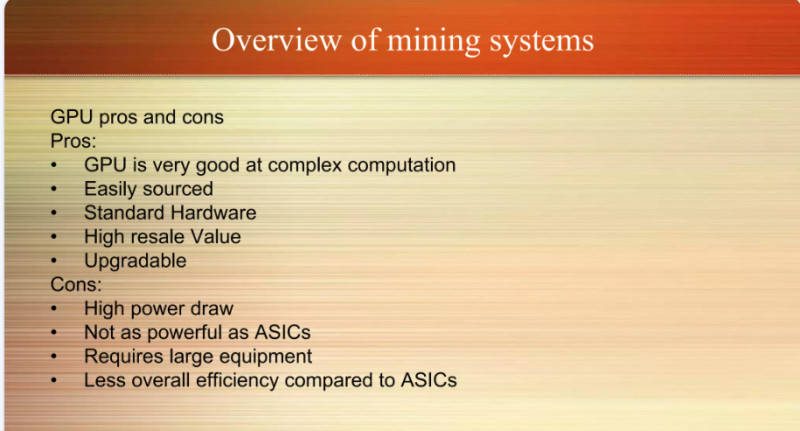
At the same time, the disadvantages of GPU mining include:
- High energy consumption. Mining with GPUs requires large amounts of electricity due to their heavy computational workload. In regions with high electricity costs, this can become a major expense.
- Heat generation. As a consequence of the high workload, GPUs produce large amounts of heat, which may lead to overheating if they are not properly placed or sufficiently cooled. Often, additional cooling equipment such as fans or air conditioners is required.
- Lower efficiency compared to ASIC miners. ASICs are far more powerful and productive. GPUs, being general-purpose devices, are not optimized specifically for mining, which makes them less effective, especially for Bitcoin.
- Additional maintenance costs. While GPUs are cheaper than ASICs at the start, users often face ongoing expenses for repairs or replacements due to the heavy loads that graphics cards are not originally designed to withstand.
Conclusion
In this article, we have reviewed how GPU mining works. Many believe that this type of cryptocurrency mining is already outdated and inefficient, but that is not entirely the case. Indeed, for Bitcoin mining, such equipment is no longer suitable, as it cannot withstand the strong competition from ASIC miners.
However, there are still a number of other digital currencies that can be mined with graphics cards. Moreover, thanks to their versatility, GPUs make it possible to mine different coins, switch from one cryptocurrency to another depending on profitability, or even mine several at the same time.
In general, graphics cards have a much broader application. When they are no longer powerful enough for mining, users can still resell them at a relatively high price, which allows for partially offsetting initial costs.
When calculating potential income, it is essential to account for all expenses, which include not only the cost of the equipment itself but also electricity consumption. In addition, extra costs may involve repair and maintenance as well as the purchase of supplementary equipment such as cooling devices.


 Back to articles

