



In this article, we explain how the price outlook for gold futures on the exchange is likely to develop, and the factors affecting the precious metals market.
Metals with millennia of history continue to play a key role in the modern global economy. Their significance goes far beyond a commodity function: they have become a cornerstone of financial architecture, a tool of trust and stability. Whereas in the past people embarked on long and dangerous expeditions for noble metals, today gold futures are traded every day on exchanges with no risk to personal safety. G20 central banks are increasing reserves, emerging economies are pursuing dedollarization, and large funds are diversifying portfolios with “hard assets.” The reason is preserving purchasing power and protecting capital during periods of global imbalance.
Financial contracts for deferred delivery (futures) are one of the main instruments providing liquidity and predictability in this market. These are standardized agreements that allow participants to lock in the price of an asset today for settlement in the future. They are used for two primary purposes: protection against adverse price movements and profit from price changes. Their complexity—and advantage—is a high sensitivity to macroeconomic factors: interest rates, inflation expectations, and currency policy.
The situation for 2024–2025 sharply increases interest in such assets. The world has entered a phase of geoeconomic overload. Conflict zones are multiplying. Currency wars are gaining momentum. The debt burden on the largest economies exceeds historical highs. Monetary authorities are constrained in their options: inflationary pressure prevents infinite money printing, while high rates slow growth and encourage outflows from risky segments.
Against this backdrop, demand is rising for safe and understandable ways to preserve value. Perpetual gold futures contracts have become an important indicator of sentiment and fear, while also opening opportunities for speculative play, strategic hedging, and tactical capital reallocation.
Industrial demand is also growing. The energy, electronics, medical and new-technology sectors are increasing consumption. At the same time, logistics issues, underinvestment in mining and regulatory restrictions create the risk of supply shortages. This increases price volatility and attracts short-term capital.
This piece offers a structured analysis of the situation: the key drivers of price change, an assessment of institutional and retail participant behavior, the influence of regulators and systemic events. Special attention is paid to potential scenarios for 2025 and practical strategies that can be used in a volatile market. The goal is to provide the reader not just with an overview but with an analytical tool to improve decision-making and increase asset-management effectiveness.
What are precious metals futures?
A futures contract is an agreement to buy or sell an asset at a fixed price on a predetermined future date. All parameters—including volume, quality, exchange, settlement currency and delivery terms—are standardized. The main objectives are to protect against price volatility or to earn income from changes in the underlying asset’s price. These contracts are actively used by corporations (producers, consumers, funds) as well as by private participants.

- Trades are executed on specialized exchanges. The largest are COMEX (US, part of CME Group), NYMEX (energy and metals, also under CME), MCX (India, a leading platform in Asia) and the LME (London Metal Exchange). Each has a clearing system that guarantees fulfillment of obligations and reduces counterparty risk. The precious metals market is one of the world’s largest markets.
- A feature of these contracts is that physical delivery is rare. More than 90% of trades are closed before expiration. This means trading is driven by price movement rather than ownership of the physical commodity. Exchanges require margin collateral—a deposit participants post to enter a trade. Margin size depends on volatility and the position (long or short).
- There is a distinction between instruments tied to different metals. One may have higher liquidity, another greater volatility. The former is more often used as a macroeconomic barometer, the latter as an indicator of industrial demand. Contract standards differ by lot size: on COMEX, for example, one futures contract equals 100 troy ounces of one metal and 5,000 troy ounces of another. This is important when choosing a strategy.
- Futures play a dual role. On one hand, hedging: protecting against adverse price moves. For example, a producer can lock in a price months ahead to minimize losses if prices fall. On the other hand, speculation: aiming to profit from short-term price movements. Opening a long or short position depends on expectations of rising or falling prices.
Thanks to high liquidity, standardization and transparency, this instrument has become a universal platform for gauging market participants’ expectations. Contracts instantly reflect macro events, central bank decisions and geopolitical risks. Analysis of open interest, volumes and large-player behavior helps reveal market direction.
Deferred-delivery contracts are a powerful tool both for professionals and for those building long-term financial strategies. They make it possible to control risk, scale returns and respond flexibly to changes in the global context.
Global context and key factors for 2024–2025
The global economy is moving amid heightened turbulence. Major geopolitical events of 2024 continue to increase tensions: military conflicts in Eastern Europe and the Middle East, strategic competition between the US and China, and instability along global trade routes.

Political elections in key countries add uncertainty. The US, India and several EU states have entered electoral cycles that shift priorities in foreign economic policy. This affects supplies, logistics and capital allocation.
Monetary policy of the largest central banks remains the main driver of changing macroeconomic conditions. The Fed maintains a tight stance, keeping a high policy rate to control inflation. This supports the dollar while at the same time slowing business activity. The European Central Bank is balancing between fighting price growth and supporting the eurozone’s weak economy. The People’s Bank of China is acting asymmetrically: cutting rates and supporting liquidity to stimulate domestic demand amid low inflation and problems in the property market. Thus, the global gold price outlook for 2025 depends not only on demand but also on the domestic policies of major powers.
Inflation remains persistently high in emerging markets and unstable in advanced economies. Rising prices for food, fuel, services and raw materials lead to a revaluation of assets that can preserve purchasing power. Attention is focused on the dollar (DXY), US bond yields and the spreads between corporate and government debt yields. Rising sovereign yields cause capital outflows from risky assets while putting pressure on emerging-market currencies.
The energy sector remains under pressure. Export restrictions on hydrocarbons, instability in the Middle East and reduced investment in resource exploration increase the cost of metal production. Energy is a key cost item for processing plants and mining companies. Rising oil and gas prices automatically make production less profitable, especially in regions with aging infrastructure.
A long-term structural factor is the global drive toward decarbonization. The transition to clean technologies requires increased production of solar panels, batteries, hydrogen energy and grid infrastructure. This creates strong demand for specific elements, especially those used in photovoltaics and conductors. Analysts predict consumption of these resources could rise two- to threefold by 2030, starting from the current five-year period.
The market is responding to this trend with growth in deferred-delivery contracts, indicating participants’ confidence in further price increases. This combination of political risks, limited supply, energy-system transformation and monetary pressure creates a unique historical moment when physically backed assets, such as exchange-traded gold futures, come to the fore as a strategic resource.
Overview of gold futures market
In 2024, the market showed volatility within $1,850–$2,450 per troy ounce. The main growth impulse occurred in March–April, a period when geopolitical risks intensified, concerns about banking stability flared, and expectations for a pause in US monetary tightening rose.
The summer pullback was linked to dollar strength, rising bond yields and profit-taking by large participants. In autumn, prices stabilized around $2,300, while the market remained sensitive to Fed statements and macro data.
According to the COT Report (Commitments of Traders), speculative funds increased long positions in Q1 2024. The share of longs in managed money exceeded 70%, confirming strong institutional interest. Hedge funds and CTAs focused on momentum moves, while producers actively took short positions to lock in future margins. Physically backed ETFs grew assets midyear, especially in Europe and Asia — regions with heightened demand for safe-haven assets. Emerging-market central banks continued to add to reserves, notably China, Turkey and India.
Seasonality has a noticeable effect. January, September and November traditionally show higher activity due to demand for perpetual gold futures from the jewelry industry and preparations for holidays in Asia. July and August are most often correction periods. In the broader cycle, peak activity often coincides with rate cuts and a weakening dollar. Historically, crisis periods, deflationary expectations and heightened equity-market volatility lead to sharp inflows into safe-haven assets.
Key correlations are stable. The inverse relationship with the dollar (DXY) persists: when the US currency strengthens, prices fall; when it weakens, prices rise. The interaction with equities is mixed: in stock-index corrections, demand for more stable capital stores increases. The relationship with bonds is tougher: rising US Treasury yields, ceteris paribus, put pressure on prices. However, when rate-cut expectations appear, liquidity shifts into commodity assets.
The technical picture in 2024 formed a steady upward channel. Key support is at $1,980, strong resistance at $2,450. The breakout of $2,370 in April launched a short-term bullish trend, but staying above $2,400 was hampered by heavy selling volumes. RSI, MACD and volume indicators at the peaks confirmed the market was overheated. The formation of a “flag” pattern at year-end suggests likely consolidation before the next impulse.
Contracts on this asset remain an indicator of global risk, a direction for capital in uncertainty, and a technically refined field for short- and medium-term speculation. Understanding the participant structure of the precious metals market, macroeconomic linkages and behavioral patterns makes it possible to build strategies intelligently and account for probable scenarios.
Silver futures: undervalued asset?
This metal is unique. It combines the properties of a financial instrument with those of an indispensable industrial component. It is used in electronics, medical equipment, solar panels, batteries, automotive electronics and the defense industry. Advantages include high electrical conductivity, antimicrobial properties and reflectivity. That makes demand relatively resilient regardless of the phase of the economic cycle.
In 2024 the trading range was $21–$32 per ounce. Sharp moves occurred around geopolitical escalations, inflation releases and key central-bank statements. Volatility for this asset traditionally exceeds that of many peers in the sector. That creates risks for hedgers but at the same time offers more opportunities for those trading short- and medium-term swings.
Fundamental demand is strengthening. The solar-energy sector set installation records in 2024. Each megawatt of capacity requires about 20 kg of this resource. China, the US, India and Southeast Asian countries are massively expanding panel installations. Electric vehicles contain 2–3 times more silver-based components than internal-combustion cars. Microchip production also relies on silver — it ensures precise signals and protection against overheating.
Looking at silver, the gold/silver ratio is an indicator of imbalance. Historically, a ratio around 60–70 is considered balanced. In 2024, it ranged from 80 to 90, suggesting potential undervaluation. At peaks, it exceeded 100, the levels seen only during crisis periods. When this ratio begins to fall, it often precedes a price jump for the cheaper metal.
Activity in futures markets has intensified. COT reports show a rise in open long positions among speculative participants. Physically backed ETFs recorded inflows from April through September. Bank analysts and industry funds point to a supply deficit amid stable or rising demand. Mining output is failing to keep pace with consumption — especially in Latin American countries where infrastructure is aging, and regulation is tightening.
Many view this instrument as a spring that has not fully released. Relative undervaluation, industrial importance, the green-energy transition and high sensitivity to macro factors make silver one of the most promising contracts for 2025. With a sound strategy, one can exploit price inertia and cyclicality to build strong positions.
Scenario forecast
The coming year creates several likely trajectories for precious-resource prices. Let’s try to consider the price forecast for gold in 2025. The situation will depend on US monetary policy, the dynamics of geopolitical risks and the pace of industrial demand. All key scenarios should be accounted for when building a strategy: from aggressive growth to a moderate correction. Flexibility of thought and readiness to adapt are more important than any attempt to guess the exact entry point.
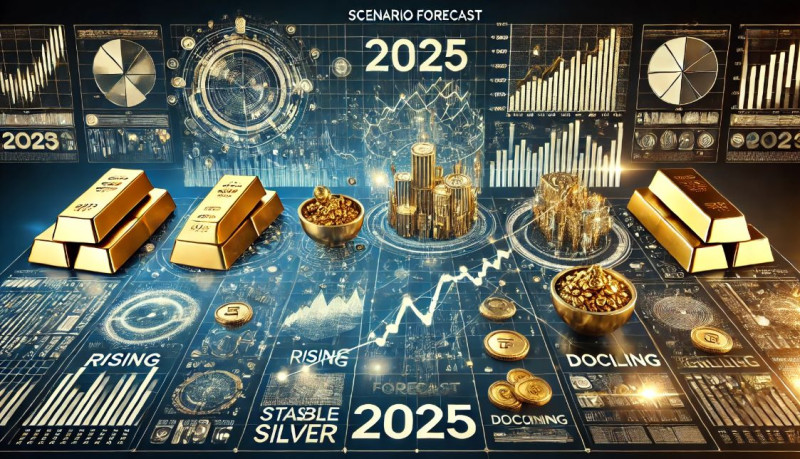
Scenario table (movement of quotes and key factors)
| Scenario | Implementation conditions | Forecast | Consequences |
| Optimistic | Federal Reserve's monetary easing (rate < 3%); US recession; geopolitical escalation; rising demand from BRICS and the East | $2,500+ / $40+ | Breakthrough of key levels; sharp liquidity inflows; strengthening role of metals as reserve assets |
| Base case | Gradual disinflation; DXY stabilization; moderate demand growth; geopolitics under control | $2,200–2,400 / $28–33 | Continued uptrend; preserved attractiveness as a hedging and insurance instrument |
| Negative | Rate hikes by the Federal reserve > 5%; dollar strengthening (DXY > 107); slowdown in Asian demand; hit to renewables and microelectronics sectors | $1,950 иlower / $22–24 | Capital outflow into bonds and the dollarreduced interest from speculators and funds; increased volatility |
All three scenarios require different capital-management approaches. The base case — gradual strengthening with intermittent pullbacks — remains the most likely. However, a sudden intensification of geopolitical or economic stressors could quickly shift the market into a bullish regime, which would put upward pressure on gold futures. Preparing for abrupt trend changes and continually revising parameters is the key to resilient results in 2025.
Strategies for traders and investors
Trading deferred-delivery contracts requires a clear understanding of market rules. Leverage amplifies returns but also increases risk. One standard contract controls a large volume of the underlying asset — on COMEX, that’s 100 troy ounces, so a $1 move equals $100 profit or loss. Exchanges require margin collateral: on average 4–8% of the notional position.

During high volatility, margin requirements can be raised. Monitoring maintenance-margin levels is key to managing liquidity. A drop in the price of a perpetual gold future below an acceptable threshold triggers a margin call and forced position closure if the account is not topped up.
Alternatives exist for those not ready to manage contracts daily. Physically backed ETFs track the underlying asset’s performance while allowing smaller capital commitments and avoiding delivery obligations. Options grant the right but not the obligation to trade, reducing potential losses. Those preferring OTC formats can use bars, coins or custody in certified banks — suitable for long-term holdings and lower correlation with financial markets.
Medium-term strategies rely on cyclicality. Analyzing seasonal patterns, reports on large players’ positions and macro indicators helps form robust entry models. It’s sensible to work in 3–12 month windows, accounting for corrections and central-bank influence. The long-term approach requires assessing trends: the energy transition, dedollarization, supply deficits and rising industrial demand. The focus should be on structural changes in supply and demand rather than short-term volatility.
In periods of high price variability, hedging becomes a survival tool. Producers and processors protect margins with short positions. Private participants lock in returns with spreads, calendar or intermarket trades. For portfolios correlated with commodities, inverse exposure can reduce systemic risk. The key is flexibility and recognizing that the precious-metals market is influenced by many factors.
Psychological resilience determines outcomes. Fast moves, media noise and unpredictable regulator decisions provoke mistakes. Discipline, scenario thinking and risk management are the basis of success. Relying on data rather than emotion separates professionals from casual participants. Foregoing the chase for short-term gains in favor of a systematic approach helps preserve positions through temporary drawdowns.
Precious-resource contracts are not merely speculative instruments. They are a field for strategic work combining logic, analysis, behavior and risk control. A successful participant uses the full toolkit: from futures to ETFs, from charts to fundamental reports, from systematic strategies to discipline.
Conclusion
The financial and commodity landscape of 2025 is being shaped by deep structural shifts. Central banks balance between inflation and recession, global conflicts destabilize markets, and the energy transition restructures supply chains. Assets that preserve value amid macro instability are coming to the forefront.
Deferred-delivery contracts on key resources remain the focus for institutional players, sovereign funds and private strategists. Speculators’ and hedgers’ behavior captures market fears and hopes faster than many indices. BRICS central-bank activity, rising industrial consumption, dedollarization, technological progress and climate change are the main drivers of the new cycle.
Scenario analysis supports the potential for steady growth if macro conditions remain as they are. With heightened crisis signals, upward moves may accelerate. If inflation stabilizes and the dollar strengthens, a partial correction is possible. The key parameters are US and Chinese monetary policy and geopolitical forks: the Taiwan situation, Europe’s energy security and conflicts in resource regions.
Although events on the other side of the world may seem remote from these precious elements, the risks are real. Exchange-traded gold futures largely depend on external economic and political factors.
Risks remain: unexpected regulator decisions, market manipulation, liquidity crises and technological failures. AI in algorithmic trading intensifies short-term swings and reduces predictability. Chaotic price moves can break strategies based on classic technical analysis. Therefore, flexibility, risk management and constant model updates are essential.
Physically limited supply and global demand with durable sectoral drivers create a unique role for these assets as a universal protection tool. They are used not only as a hedge against systemic risk but also as a diversification component not directly tied to equity or bond returns.
Passive waiting gives way to deliberate choice. Success requires not guessing price moves but a systematic approach: analysis, planning and discipline. Mastering derivative basics, working with data and understanding market behavior under instability are key skills that create a durable advantage. If you incorporate these insights and practical skills, preparing a gold-price forecast for 2025 will be straightforward.
A sound strategy is not a bet but an algorithm. Continuous learning, tuning the decision-making system, and readiness to adapt to new conditions turn market participation from a lottery into professional practice. 2025 is the time for those who act precisely, timely and deliberately.


 Back to articles

