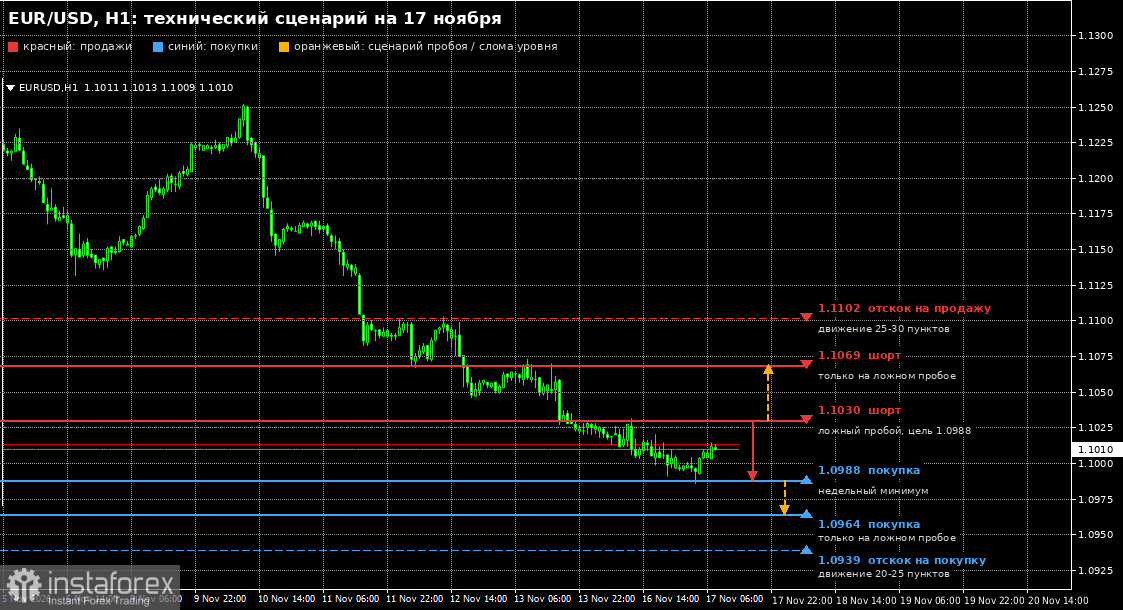
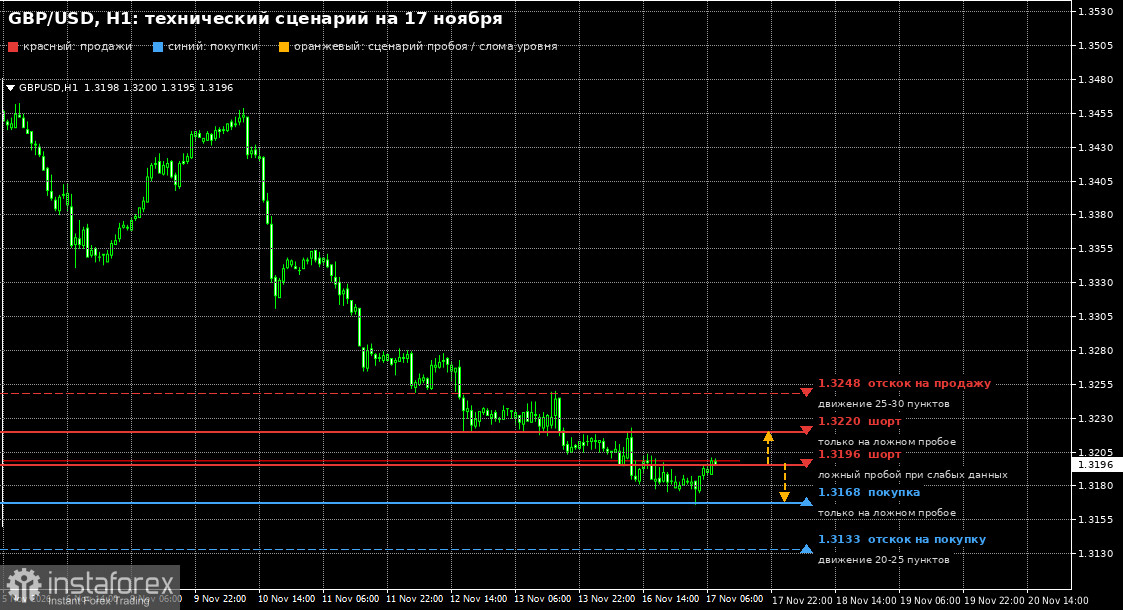
Yesterday, the euro struggled for most of the day: the market was choppy with long-wicked candles, yet overall the euro remained under pressure against the dollar. EUR/USD fell to 1.1010 by Tuesday morning from 1.1024 on Monday morning, and GBP/USD to 1.3196 from 1.3211, and both trends held in the first half of the day despite rally attempts. There are no clear prerequisites for a reversal, so it is premature to speak of a sustained recovery.
What did eurozone data show? Industrial production volume in September rose only 0.2% after -0.5% in August, and on an annual basis it fell 1.5% after a 1.1% decline a month earlier. The trend is therefore not turning but deepening. The euro received no strong support: there were rallies, but weak data led to a fresh sell-off. For a region where the ECB deposit rate is 2.50% and a rise to 2.75% is expected on December 17, such industrial dynamics remain a main argument against talk of a durable recovery.
Attention then shifted to the U.S. The New York manufacturing index fell to 7.8 from 25.5 a month earlier—nearly a threefold drop. Why did this failure not help the euro? The fact is that the day's main event was Fed chair contender Kevin Warsh's speech, and no concrete policy signal was expected from him—and that is what happened. The principal theme was artificial intelligence: Warsh stressed that security must be treated very seriously, because the situation could get out of control and harm not only the economy but also political stability. He acknowledged AI creates new jobs and urged caution with a focus on safety.
Recall Warsh has not previously revealed his cards. On October 16 he said he does not pre-decide meetings, and after the October decision he said he does not trust preliminary out-of-crisis signals and would not forecast December. Yesterday's remarks were therefore unsurprising, and in my view, as long as he remains silent on rates, the market will rely on comments from other committee members. Those speakers have kept dollar demand alive.
Beth Hammack's shift in tone is notable. On November 5 she expected a move to a restrictive stance and preferred more frequent small steps; on October 28 she voted for a hike. Now she said inflation raises questions and rates need to be raised more aggressively than the committee has done so far. Against this backdrop the probability of a December hike stands at 99%, and the market continues to price moves in January and March. Even the slowdown in producer prices to 0.3% after 1.4% in September did not change this: the funds rate remains in the 3.75–4.00% range, and pressure on the euro, the pound, and other risk assets persists.
As for today, there is quite a lot of data. In the first half of the day, the focus is on the U.K.: employment change and the unemployment rate for September (forecast 4.7%). These are September numbers and unlikely to cause strong volatility. Previously in August unemployment fell to 4.7% from 4.9%, while initial jobless claims rose to 30.3k versus a 19.4k forecast, and the pound rallied then. Now October claims are expected to be around 25k after 30.3k, and average weekly earnings ex-bonus are forecast to be at 3.5% y/y after 3.7%. If wages beat forecasts, demand for the pound will rise and pressure on Bailey to continue raising rates will increase, given the Bank of England last week raised rates to 4.00% with a unanimous 9-0-0 vote. Again: the pound will get a recovery chance only on better-than-expected data. Selling is gradually slowing, and after a large dollar rally, a pause looks logical.
For the eurozone, the main release is the ZEW economic sentiment index. Germany's current conditions index for November is forecast at -35 after -35.9 in October, and the Germany expectations index is at 28.8 after 28.1. For the eurozone as a whole, expectations are forecast to improve from 18.5 to 19.1, whereas October's reading was notably worse than a 24.2 forecast. If the data beat, the euro will gain a chance for further recovery and an upside correction versus the dollar.
Stronger dollar moves may come from U.S. releases. First, retail sales for October are forecast to rise only 0.1% after 0.8% in September. If the print disappoints, dollar demand will weaken, and the euro and pound will get a better chance for a larger recovery. U.S. industrial production for October is also interesting: flat after +0.7% in September, and manufacturing +0.2% after +0.3%. In addition, Williams and other Fed officials will speak, as will ECB chief economist Philip Lane. There are many events and politician interviews today, so the day promises to be busy.
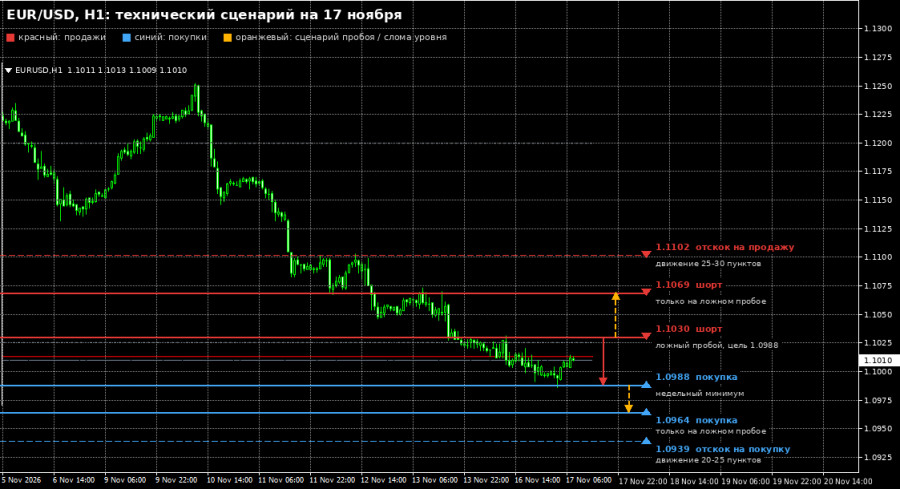
The technical picture for EUR/USD (1H) shows that for shorts there is a level at 1.1030: a false break there would be a reason to open short positions, at least toward the lower boundary and the weekly low at 1.0988. If the pair falls in the first half of the day, active buyer action at 1.0988 would be a cue to open longs. A break above 1.1030 would give a chance to strengthen after weak U.S. retail numbers toward 1.1069. Short positions there on a false break, and I will sell bounces from 1.1102 for 25–30 pips. If buyers fail at 1.0988, the next focus is 1.0964: buy false breaks there, or buy the bounce from 1.0939 for 20–25 pips.
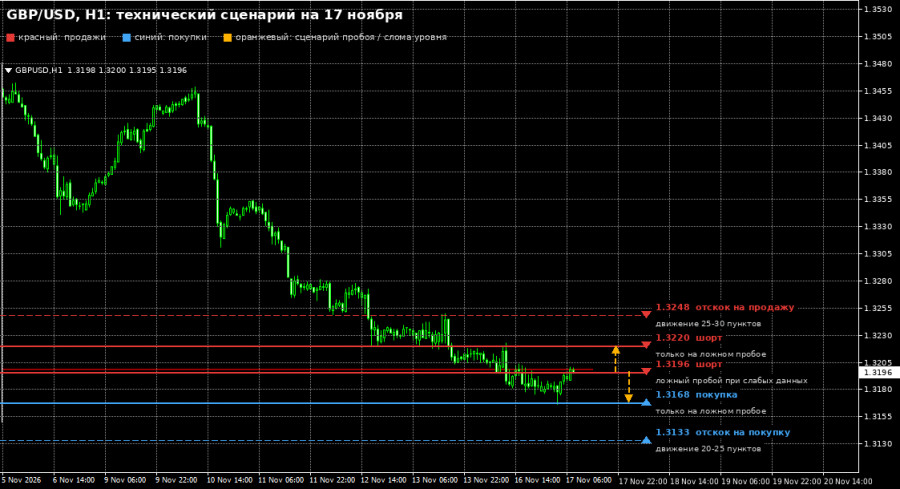
As for GBP/USD, the focus is on labor data. Good prints will push the pound up toward 1.3220, where I will sell false breaks. If data disappoints, a false break at 1.3196 is also a reason to scale into shorts. If bears are inactive, I look to sell the bounce from 1.3248 for 25–30 pips. For buys against the downtrend, exercise caution: only after a break and hold above 1.3196, or consolidation at that level, or a false break at 1.3168. I will only buy bounces from the new weekly/monthly low in the 1.3133 area for 20–25 pips.
Bottom line for the day: the dollar keeps the edge thanks to the Fed's tough tone and a 99% chance of a December hike; weak eurozone industry and Warsh's silence on rates leave the euro and pound vulnerable. I think the market needs a pause after the weekly lows, and a correction to upper levels is possible, but I lean toward that remaining a correction unless UK wages beat or U.S. retail collapses. I do not expect both releases to be disappointing, in which case the recovery could be larger than most now expect.