Analysis of Trades and Trading Tips for the Japanese Yen
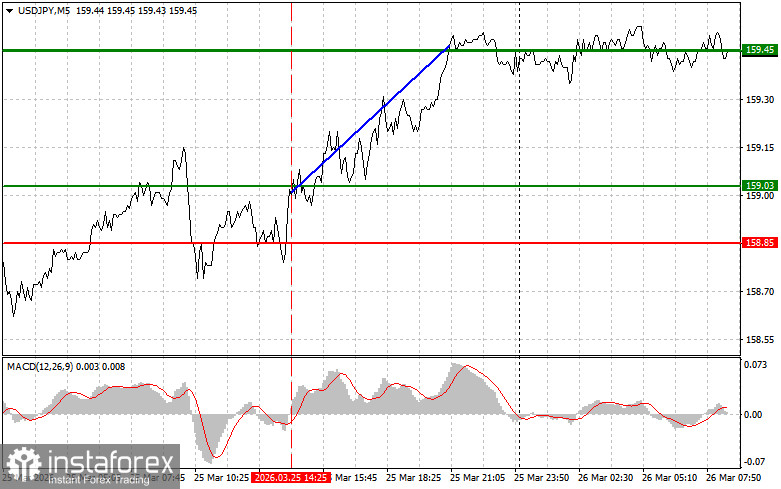
The price test at 159.03 coincided with the MACD indicator just beginning to move upwards from the zero mark, confirming the correct entry point for buying the dollar. As a result, the pair rose towards the target level of 159.45.
Yesterday, the US dollar rose sharply against the yen amid heightened geopolitical tensions following Iran's rejection of the US peace proposal. Investors seeking to minimize risk began actively converting their capital into US dollars, driving the US dollar's value higher against major world currencies, including the Japanese yen. The further development of the situation will depend on Washington's reaction to Tehran's counterproposal. If the negotiation process stalls and the rhetoric from both sides continues to escalate, further strengthening of the dollar and a decline of the yen can be expected. At the same time, the existence of alternative terms proposed by the Iranian side may open the door to a new round of diplomatic maneuvers, which, in turn, could lead to some stabilization and, subsequently, a correction in the dollar's value.
Today's data on the core consumer price index from the Bank of Japan was completely ignored by traders.
As for the intraday strategy, I will primarily rely on the implementation of Scenarios #1 and #2.
Buying Scenarios:
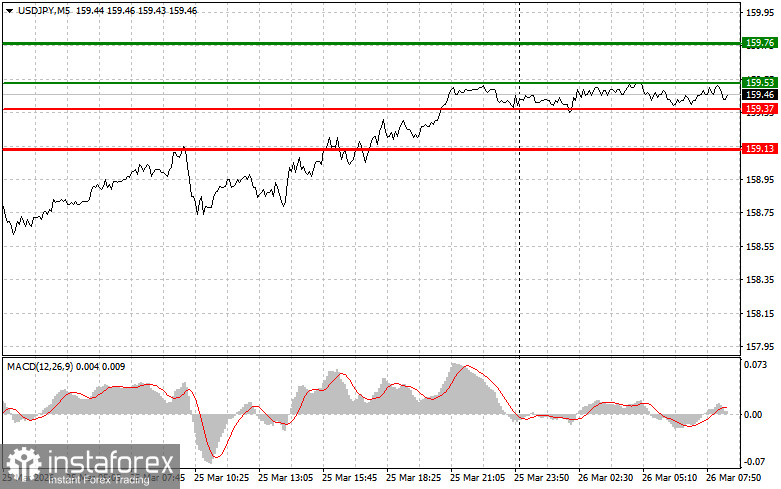
Scenario #1: I plan to buy USD/JPY today upon reaching an entry point around 159.53 (green line on the chart), with a target for growth towards 159.76 (thicker green line on the chart). At around 159.76, I intend to exit my long positions and open shorts in the opposite direction (aiming for a movement of 30-35 pips in the opposite direction from the level). It is best to resume buying the pair on corrections and on serious dips in USD/JPY. Important! Before buying, ensure the MACD indicator is above the zero mark and just starting an upward move from it.
Scenario #2: I also plan to buy USD/JPY today in the event of two consecutive tests of the price 159.37 when the MACD indicator is in the oversold area. This will limit the downside potential of the pair and lead to a market reversal upwards. One can expect growth towards the opposite levels of 159.53 and 159.76.
Selling Scenarios:
Scenario #1: I plan to sell USD/JPY today only after the 159.37 level is updated (red line on the chart), which will trigger a rapid decline in the pair. The key target for sellers will be the 159.13 level, where I intend to exit my shorts and open longs immediately in the opposite direction (aiming for a move of 20-25 pips in the opposite direction from the level). It is better to sell as high as possible. Important! Before selling, ensure the MACD indicator is below the zero mark and just starting its downward move.
Scenario #2: I also plan to sell USD/JPY today in the event of two consecutive tests of the price 159.53 when the MACD indicator is in the overbought area. This will limit the upside potential of the pair and lead to a market reversal downwards. One can expect a decline towards the opposite levels of 159.37 and 159.13.
What's on the Chart:
- The thin green line represents the entry price at which you can buy the trading instrument;
- The thick green line is the assumed price where you can set Take Profit or manually take profit, as further growth above this level is unlikely;
- The thin red line indicates the entry price at which you can sell the trading instrument;
- The thick red line is the assumed price where you can set Take Profit or manually take profit, as further decline below this level is unlikely;
- The MACD indicator. When entering the market, it's important to refer to the overbought and oversold zones.
Important: Beginner traders in the forex market need to make entry decisions very carefully. It is best to stay out of the market before the release of important fundamental reports to avoid sharp fluctuations in prices. If you choose to trade during the release of news, always set Stop Loss orders to minimize losses. Without placing Stop Loss orders, you can quickly lose your entire deposit, especially if you do not use money management and trade large volumes.
And remember, successful trading requires a clear trading plan, like the one presented above. Making spontaneous trading decisions based on the current market situation is inherently a losing strategy for intraday traders.