The midterm elections in the U.S. Congress, taking place tomorrow, November 3, are important: their results will largely determine how freely Donald Trump can implement his agenda during the remaining two years of his presidency. The vote also matters for the dollar, because the balance of power in the chambers will shape fiscal policy prospects, inflation, and future Fed decisions. Therefore, the headline link "Republican victory — stronger greenback" appears logical, although it requires several caveats.
Briefly: these are called midterm elections because they occur halfway through a four?year presidential term. House members are elected for two years, and senators for six years, with the upper chamber renewed in stages. This cycle contests all 435 voting House seats and 35 Senate seats (33 in the regular rotation and two in special elections in Florida and Ohio).
For the president this is effectively a midterm exam. By this moment voters' initial expectations collide with real policy results, responsibility for economic and foreign?policy problems accrues to the administration, and accumulated discontent mobilizes the opposition electorate. Therefore, the incumbent party typically loses House seats, although exceptions exist—for example, in 1998 and 2002.
Losing control of Congress can turn the White House into a so?called "lame duck," that is, a leader who formally retains full powers but faces serious obstacles in implementing his agenda.
It is worth noting that even media outlets friendly to Republicans now acknowledge risks for the president's party. While liberal press outlets discuss the possibility of a serious GOP defeat, polls show Democratic advantages. For example, an October CNN/SSRS survey found Democrats ahead by 10 percentage points. Subsequent CNN analyses indicated Democrats have a shot not only at the House majority but also at the Senate, though taking the upper chamber remains uncertain.
An October Economist/YouGov poll also recorded a Democratic lead: 46% versus 40% among registered voters and 52% versus 41% among those "definitely planning to vote." By the way, such a gap implies turnout could play an important — and possibly decisive — role in the outcome.
Even conservative Fox News, which traditionally leans Republican, does not promise them victory: its final Senate map gives Democrats the edge for 48 seats versus 46 for Republicans. The New York Post, close to Trump, concedes a Democratic advantage in the House race while calling the Senate outcome, in the paper's view, "uncertain."
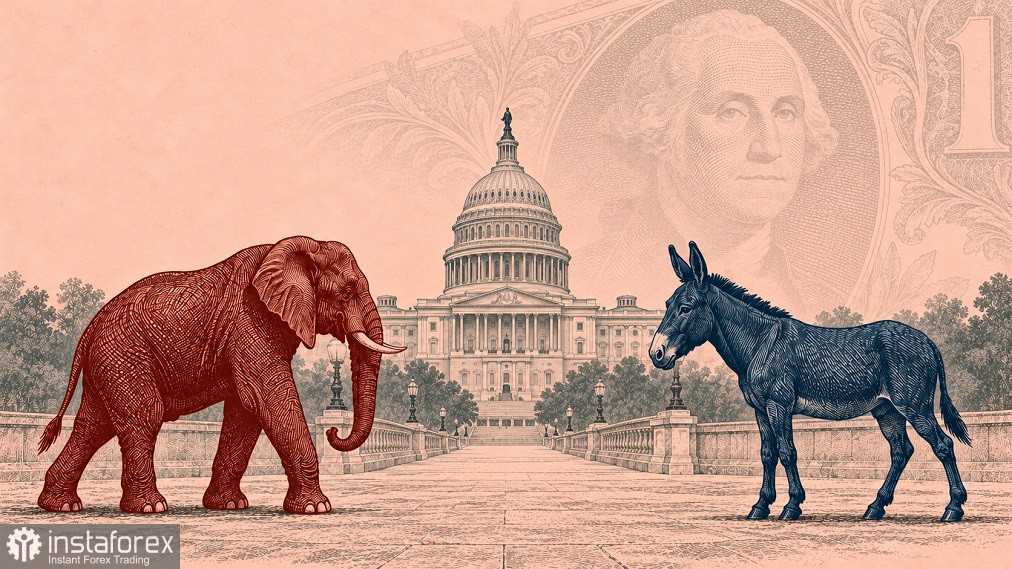
Thus, Democratic donkeys and Republican elephants—the traditional party symbols—approach the decisive vote with Democrats holding an advantage, although the final result is far from settled.
Separately, Polymarket's forecasts deserve mention. Today the platform prices roughly a 72% chance that Democrats win both chambers, while the probability that Republicans retain the Senate if Democrats win the House is about 22%. The odds of Republicans holding both chambers are estimated at only 6%. Of course, this is not sociology: Polymarket participants do not fully represent the American electorate, and prices depend on liquidity and large trades. However, those markets help gauge prevailing expectations and the degree of surprise baked into prices.
As we see, some uncertainty remains, so the natural question is, how will the greenback react to each possible election outcome? Let us consider scenarios and assess the dollar's likely response to each.
Start with the least likely. If Republicans retain both chambers, this would be an unexpected and welcome surprise for dollar bulls. Unified party control would ease passage of tax cuts and budget initiatives. If the market sees prospects for additional stimulus that boost demand and inflation, Fed rate expectations could shift toward tightening. That scenario would put pressure on EUR/USD. But one should note that a GOP win by itself does not guarantee stimulus: initiative content and party unity matter. Also remember that a rise in Treasury yields driven by expectations of a hawkish Fed is more dollar?friendly than a yield increase driven by concerns over fiscal sustainability. Therefore, in the short term the greenback would likely strengthen materially, but sustained gains would require additional fundamental signals.
If Democrats win only one chamber, the most likely case is the House falling under their control while the Senate remains Republican. Even such an outcome would significantly complicate the White House's legislative agenda. The likelihood of large new fiscal stimulus would fall, which could reduce inflationary pressure and lower odds of further Fed hikes. The greenback would, accordingly, face background weakening.
There is an important nuance. The market has already priced much of the risk of Republicans losing the House. Moreover, given the substantial probability of Democrats winning both chambers shown in some measures, Republicans holding the Senate might be perceived as relatively favorable for Trump. Therefore, the dollar's initial reaction could be neutral or even positive.
If Democrats win both chambers, the White House's legislative scope would be sharply constrained. Accordingly, such a scenario would likely trigger a more pronounced weakening of the greenback. But remember: the opposition would still not be able to implement its program unimpeded. The president retains veto power, and overcoming vetoes requires two?thirds majorities in each chamber—which the Democrats will not have after the forthcoming vote.
Under that "Democratic" scenario much will depend on Donald Trump's subsequent actions. If the president concedes defeat and agrees to compromises with Democrats, the greenback would most likely come under moderate pressure. After all, the odds of large new fiscal stimulus would decline, and with them, expectations of additional inflationary pressure.
A very different picture would emerge if the White House chooses a path of hard confrontation. Recall that Trump has recently signaled a readiness to use veto power actively—calling himself a potential "Mr. Veto"—while at the same time not ruling out situational deals with Democrats.
It is too early to say that political confrontation under a Democratic Congress will necessarily become protracted. Nevertheless, that risk exists. Continuous bill blockages, budget disagreements, and the threat of another prolonged shutdown could spur a rise in risk?off sentiment. In that case the dollar could initially strengthen (driven by safe?haven demand), and EUR/USD could decline even amid a Democratic victory.
The intrigue persists also because U.S. polls have repeatedly erred. For example, in 2016 national polls fairly reflected Clinton's lead in the popular vote, but state?level surveys underestimated Trump. In 2020 polls correctly identified the winner but overstated Biden's margin. Two years ago Donald Trump won more convincingly than many analysts expected—and he prevailed both in the Electoral College and in the national vote.
All this suggests that even a substantial polling lead for Democrats does not guarantee them victory in congressional elections. One reason is that many Republican supporters are less likely to participate in polls than Democratic supporters, which biases results.
In my view, the dollar does indeed benefit from "rooting for the elephants," because a Republican victory would raise the odds of fiscal stimulus and a firmer Fed policy path. However, much will depend on how election results match forecasts and what stance the White House adopts toward the newly configured Congress. Therefore, ahead of the vote, it is prudent to take a wait?and?see position on EUR/USD. It is possible that the market's first reaction to the results will be overly emotional and that the initial price move will be misleading.