




Let’s be honest — having your own Forex account looks cool and prestigious. More importantly, it’s a must if you want to trade on the currency market.
Below, we explain the steps you need to take, what the different account options mean, and how to choose the one that suits you best.
Why is it important to open an account?
You’ve probably heard about the profits Forex trading can bring. Why not give it a try?
If you’re ready, the first thing you need is a trading account. Think of it like a bank account: you can deposit and withdraw funds as needed.
Importantly, the account is not opened on the Forex market itself. Brokers, such as InstaForex, act as intermediaries between private traders and the international currency market. You open your account with a broker, who provides access to trading and the market infrastructure.
Without an account, you can’t participate in the global currency market — so profits will remain just a dream.
What a trading account lets you do:
- open and close trades, and thus potentially earn profit (of course, Forex can also lead to losses);
- deposit to and withdraw from your trading account;
- use the trading terminal/platform;
- receive bonuses, enter contests and take part in promotional offers that brokers provide; and
- use various trading services, like copying successful traders or joining a PAMM system.
How to open a forex account
As noted above, you open an account with a brokerage company. The basic steps are:
- Research brokers and gather information about them;
- Choose the company that best meets your needs and expectations;
- Register on the broker’s website;
- Verify your personal data;
- Fund your account;
- Start trading.
All steps typically take no more than 15 minutes. Below, we break them down in more detail.
Choosing a broker
There are many brokers, so don’t pick the first one you see. What to pay attention to:
- Experience. Look for at least 5 years on the market. For example, InstaForex has been operating since 2007.
- Licensing and regulation. Beware of scams pretending to be brokers.
- Reputation. Brokers present themselves positively on their sites, so read independent user reviews.
- Commissions. The lower the fees, the better.
- Trading conditions: available instruments, leverage, execution quality, etc.
- Bonus programs and promotions. Not the most important factor, but a nice extra.

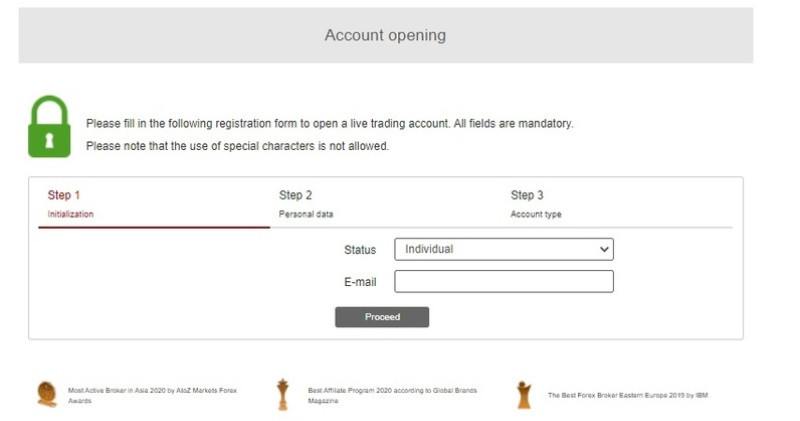
Once you’ve chosen a broker, click “open account” on their website and fill in the registration form.
Demo account: where a beginner should start
Jumping straight into live trading is risky. It’s better to start with a demo account — see our article “What is a demo account on Forex?” for more.
As a beginner, you may struggle with emotions or lack the market knowledge needed to make sound decisions. You don’t want to lose your money on the first steps.
A demo account lets you:
- learn how Forex works and get familiar with the trading terminal;
- practice reading charts and analyzing trends;
- practice technical execution;
- test a trading strategy;
- assess your skill level as a trader.
In short: you trade without risking a cent, gaining experience and practice — but no real profit.
| Pros of a demo account | Cons of a demo account |
| No risk of losing real money | It does not convey the psychological pressure of real trading |
| You can learn the trading platform and tools | Order execution is sometimes more ideal than in reality |
| It allows you to test a strategy | It doesn't teach you how to manage emotions during drawdowns |
Read our guide for more on how to open a demo account.
Beginners can’t do without a demo account — before trading live, you need to learn how to trade properly and sharpen your skills. But don’t get carried away with it for too long. First, you won’t earn real money; second, you’ll get used to not being accountable for losses.
You can also create a practice account directly in trading terminals — for example, in the popular MetaTrader 4.
Available MT4 versions:
- mobile;
- desktop.
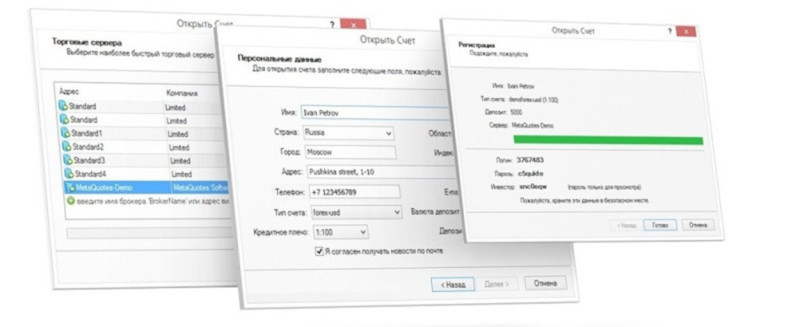
Here are the main steps you need to go through.
Opening a demo account in MetaTrader 4:
- Go to the platform’s official website;
- Install the program on your device — computer or smartphone;
- Launch the terminal;
- In the server list, choose MetaQuotes Demo;
- Complete the registration;
- Choose the account type and leverage;
- Confirm the action.
Done — now you can start. No deposit or verification is required.
Why do you need a trading platform?
If you’ve decided to conquer the currency market, don’t wait. We recommend reading our informative article “How to open a live Forex account on MetaTrader 4” to start correctly.
You’ve probably noticed that MT4 is most often mentioned when trading terminals are discussed. Here’s why.
First, it’s a completely free trading platform that traders around the world use to earn on Forex. It works on PCs and laptops as well as on tablets and smartphones.
The platform was launched by MetaQuotes in the early 2000s. Since then, it has not only remained relevant but increased its standing — unsurprising, since the platform is constantly updated.
MetaTrader 4 is a trader’s workspace — like a piano for a musician.
What MetaTrader 4 offers:
- real‑time quotes;
- timeframes from M1 to MN (one minute to one month), with the ability to add custom intervals;
- everything for technical analysis: indicators, charts, etc.;
- order‑opening functionality;
- news feed;
- trade history archive;
- Stop Loss, Take Profit and other risk‑management tools.
This is just the most important of what the platform’s developers provide to users.
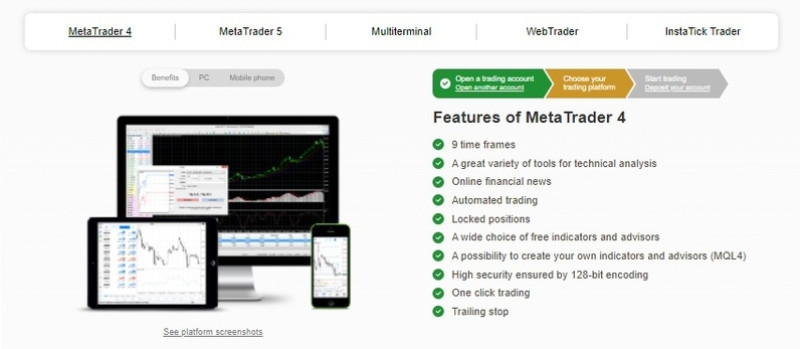
When you first open the MetaTrader 4 workspace, the abundance of panels, numbers, and buttons may make you think you’ll never figure it out. But that’s not the case.
Start by learning the menu sections (File, View, Insert, etc.), and everything will fall into place.
What if you don’t want to download and install anything on your computer or phone? For that case, InstaForex offers a convenient, modern alternative — a branded web trading platform. It runs in your browser and is virtually no different from classic desktop apps. You get instant access to live charts, up‑to‑date quotes, technical analysis tools and one‑click order entry. It’s an ideal option for anyone who wants to monitor the market from any internet‑connected device. The platform looks stylish and is intuitive to use.
How to open a live forex account
We already explained that a real account is where everything is real: you deposit real money and trade with it. The result is either profit or loss.
Now let’s walk through the main steps using InstaForex as an example, assuming you chose this broker.
How to open a live account:
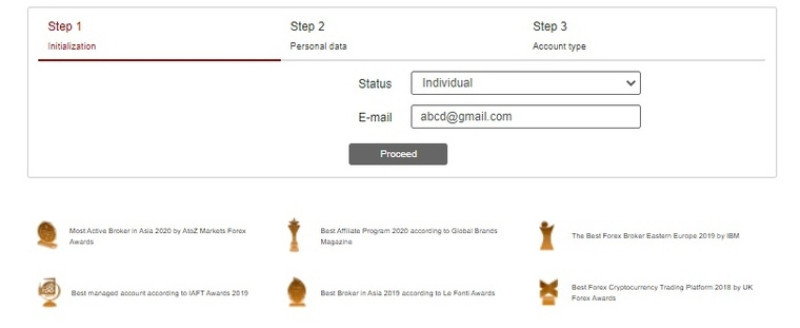
- Complete the initialization. Indicate whether you are an individual or a legal entity, provide your e‑mail and choose the platform (MT4 or MT5).
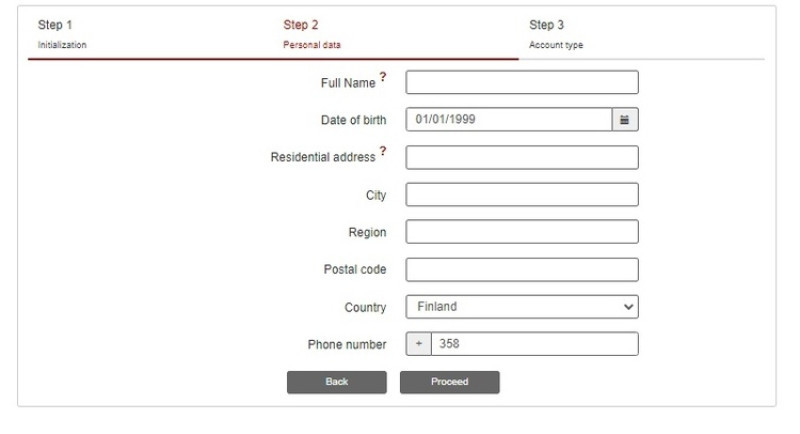
- Enter your personal data. Be sure to fill in all required fields.
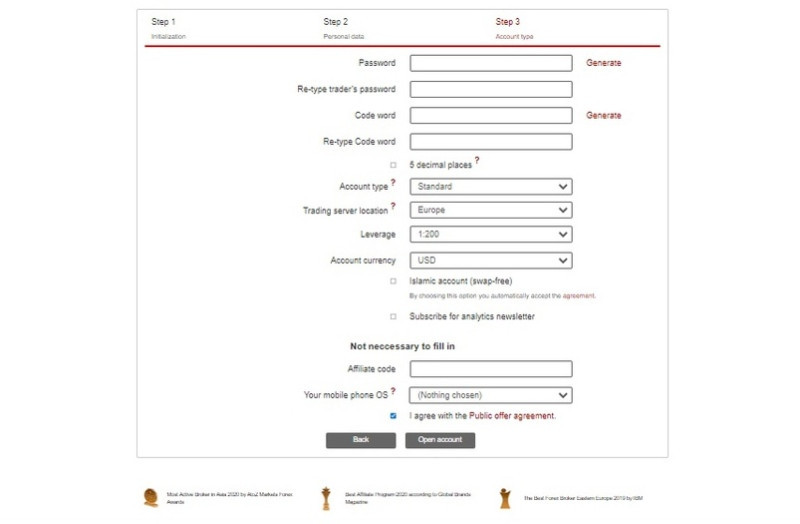
- Choose the account type. At this stage, pick an account type (Insta.Standard, Insta.Pro, Insta.Zero, Insta.Raw or Insta.Cent), the deposit currency (USD, EUR, RUB), leverage, create and confirm a password. Choose the currency you actually have, since you’ll use it to fund the account. Leverage can be changed later (the broker can set it as high as 1:5000).
- Check the details. Some fields are prefilled by the system (for example, the server). Make corrections if necessary.
- Read the public offer agreement — an important document we covered before — and confirm account opening.
- Complete verification. Note that verification at InstaForex is not mandatory, but if you verify, you get benefits: bonuses, additional deposit options, etc. Photos must be clear, and the information on documents must be easily readable.
- Install the trading terminal. InstaForex even provides a comparison of MT4 and MT5 to help you choose the optimal option.
- Fund your account and start trading.
Below, the main steps are shown in images so you can more easily see what to do.
The Forex market is open to people with different financial means. Some have thousands in their accounts; others open an account with the minimum possible amount. Brokers now offer flexible formats for any strategy. Let’s look at them in more detail.
Trading in cents (Insta.Cent account)
Don’t want to risk large sums? Invest the minimum — the Insta.Cent account is ideal for beginners and cautious traders. The minimum deposit here is just 1 USD.
On a cent account, balances are shown in cents. For example, if you deposit $10, your balance will be displayed as 1000 cents.
Is this just about converting dollars into smaller units? Definitely not. Here’s an example:
- We are interested in the EUR/USD pair at 1.0810;
- We have a cent account;
- We open a buy order for 0.1 lot, expecting the euro to rise;
- Things don’t go as planned, and EUR falls to 1.0795 — a move of 15 points;
- We close the order and lose 15 cents;
- If we had a standard account, we would have lost $15.
Yes, a cent account protects traders from very large losses and allows them to test trading strategies with minimal risk. There are no commissions on it, and spreads start from 0.00006. But profits will also be modest — keep that in mind.
Strengths of Insta.Cent:
- very small required deposit (from 1 USD);
- low risk;
- optimal for testing a strategy and learning to trade;
- a great way to evaluate the broker’s trading conditions.
Weaknesses:
- does not generate large profits;
- reduces the sense of responsibility for mistakes.
Universal approach and Mini/Micro formats (Insta.Standard account)
If you’re already familiar with the currency market, you’ve probably heard of “Mini” and “Micro” levels. Previously, these required separate accounts. Now it’s much more convenient: the Insta.Standard account is a universal USD solution that combines all these formats.
The minimum deposit also starts at 1 USD, with no maximum limit. The key is that this account allows trading volumes from 0.01 up to 10,000 lots.
What is one lot? The standard lot size on Forex is 100,000 units of the base currency.
- Micro Forex (micro‑lot): 0.01 lot (1,000 units). Suitable for deposits from 1 USD.
- Mini Forex (mini‑lot): 0.1 lot (10,000 units). Optimal for deposits from 100 USD.
- Standard Forex (standard lot): 1 lot (100,000 units). For deposits from 1,000 USD.
So you can smoothly scale up trade sizes on a single account as your experience grows, giving you flexibility and risk control. Trading is offered with spreads from 0.00006 points and no commissions.
For professionals: Insta.Pro, Insta.Zero and Insta.Raw
If you aim for active trading, scalping or news trading, accounts with deposits from 100 USD are suitable. They are designed for traders who need speed and minimal costs:
- Insta.Pro: Ideal for active traders. You get tight spreads from 0.00004 points and no commissions.
- Insta.Zero: For traders who prefer precise entry without spread widening. Trading has zero spreads, but a fixed commission is charged per trade starting from 0.5 USD.
- Insta.Raw: Built for transparency lovers. You trade with raw market spreads (from 0 points) and a fixed commission of 0.5 USD — very efficient for scalping and intraday trading.
Leverage up to 1:5000 is available on all these accounts. Leverage can magnify position size — for example, with 1:100 leverage, the trade volume is 100 times larger for the same starting capital. Larger position size means larger potential profits — and larger potential losses.
Summary / Tips
We’ve covered a lot of useful information. Time for conclusions.
How to trade on Forex:
- Open a trading account with a reliable broker — this is where your funds will be held.
- Store your login and password in a safe place — relying solely on memory is risky.
- Decide how much you’re willing to invest and choose the right account type. If the amount is small, start with Insta.Cent or use micro‑lots on the universal Insta.Standard. If you plan active trading—consider the professional plans (Pro, Zero or Raw).
- You can deposit into and withdraw from your account.
- The account is the interface for your trading and comes with many helpful features.
- Start with a demo account. After practicing there, you’ll better assess your skills and chances.
- If you want passive income, consider copy‑trading services or a PAMM system — these are available at most brokers.
- Use leverage prudently. The most common leverage is 1:100; beginners may use 1:10–1:50.
- Trade according to your chosen strategy — test it on a demo account first.
- Don’t expect huge profits, especially at the start. Be prepared for losing trades — they are inevitable.
Conclusion
Opening an account is one of the essential steps every trader must take to trade and earn on Forex. People with different starting capital can enter the market — that’s why different account types exist.
The funds in your account are your property, so you can manage them as you see fit. Do you think EUR will strengthen against USD? Open a buy position on EUR/USD and monitor quotes. You don’t need hundreds or thousands of dollars to start — you can begin with $10–50 in the account.
Sounds tempting, right? Why not try?
To save time searching for a broker, we recommend InstaForex — but the choice is yours.


 Back to articles

